Stripe Webhook Reconciliation: Ensuring Idempotent Subscription Billing
A technical guide to handling out-of-order and dropped Stripe webhooks using monotonic state machines and the transactional outbox pattern.
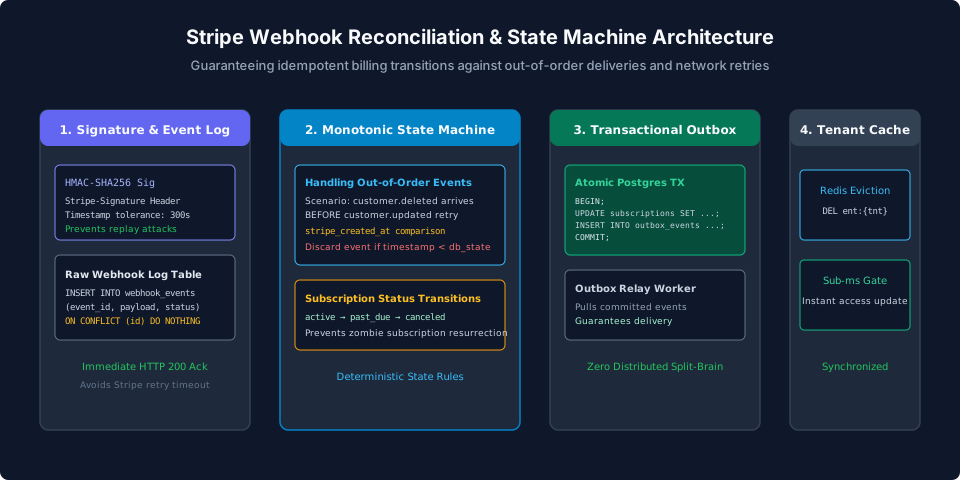
Integrating Stripe into a cloud software application is deceptively straightforward during initial testing. You generate a checkout session, listen for checkout.session.completed, and grant the customer their subscription tier.
In production, however, payment gateways communicate across an unreliable public internet. Webhooks are delivered with at-least-once semantics: network hiccups cause Stripe to retry the identical webhook multiple times; transient latency spikes cause events to arrive out of chronological sequence; and deployment restarts cause dropped webhook payloads.
If your webhook handler is not strictly idempotent and monotonically ordered, disaster follows:
- A customer who canceled their account is downgraded, but a delayed
invoice.payment_succeededretry arrives minutes later, resurrecting the subscription and billing them again. - An upgrade webhook fires twice, creating duplicate invoice records in your accounting database and double-counting revenue.
- A database lock timeout drops a webhook, leaving an enterprise customer stuck on a free trial despite paying $10,000.
This guide provides the complete architectural framework for building a bulletproof, idempotent Stripe webhook reconciliation engine using monotonic state machines and the Transactional Outbox pattern.
The Core Rule: Verify Signatures Immediately
Before your application deserializes or processes any JSON payload, it must verify the Stripe-Signature header using HMAC-SHA256 and your endpoint's secret key (whsec_...). This prevents attackers from forging fake payment webhooks to gain unauthorized access to paid features.
package billing

import (
	"io"
	"net/http"

	"github.com/stripe/stripe-go/v78"
	"github.com/stripe/stripe-go/v78/webhook"
)

func (s *BillingServer) HandleStripeWebhook(w http.ResponseWriter, r *http.Request) {
	const maxBodyBytes = int64(65536) // Protect against oversized payloads
	r.Body = http.MaxBytesReader(w, r.Body, maxBodyBytes)

	payload, err := io.ReadAll(r.Body)
	if err != nil {
		http.Error(w, "Error reading request body", http.StatusBadRequest)
		return
	}

	sigHeader := r.Header.Get("Stripe-Signature")
	event, err := webhook.ConstructEvent(payload, sigHeader, s.webhookSecret)
	if err != nil {
		http.Error(w, "Invalid webhook signature", http.StatusBadRequest)
		return
	}

	// Signature is cryptographically verified; proceed to idempotent persistence
	if err := s.processIdempotentEvent(r.Context(), event); err != nil {
		s.logger.Printf("Failed to process webhook %s: %v", event.ID, err)
		http.Error(w, "Processing failed", http.StatusInternalServerError)
		return
	}

	// Always return HTTP 200 OK immediately
	w.WriteHeader(http.StatusOK)
}
Idempotent Ingestion via Database Unique Constraints
Never perform business logic directly upon receiving a webhook. The first and only synchronous action your HTTP handler should perform is writing the raw event to an append-only stripe_events table in PostgreSQL.
PostgreSQL enforces uniqueness on stripe_event_id:
CREATE TABLE stripe_events (
    id UUID PRIMARY KEY DEFAULT gen_random_uuid(),
    stripe_event_id TEXT NOT NULL UNIQUE,
    event_type TEXT NOT NULL,
    payload JSONB NOT NULL,
    status TEXT NOT NULL DEFAULT 'pending', -- 'pending', 'processed', 'ignored'
    stripe_created_at TIMESTAMPTZ NOT NULL,
    received_at TIMESTAMPTZ NOT NULL DEFAULT NOW()
);
When Stripe sends a retry for an event you have already received, the database insertion safely ignores it using ON CONFLICT DO NOTHING:
INSERT INTO stripe_events (stripe_event_id, event_type, payload, stripe_created_at)
VALUES ($1, $2, $3, $4)
ON CONFLICT (stripe_event_id) DO NOTHING;
If zero rows were affected, the event was already recorded; return HTTP 200 OK immediately. This guarantees that duplicated deliveries from Stripe are eliminated at the database door.
The Out-of-Order Trap: Building Monotonic State Machines
A severe bug in naive webhook consumers is processing events based on arrival time rather than event generation time.
Consider this real-world production race condition:
- Monday 10:00:00: User downgrades their plan. Stripe generates
customer.subscription.updated(Plan: Free,created = 10:00:00). Network fails; Stripe schedules a retry. - Monday 10:02:00: User changes their mind and upgrades. Stripe generates
customer.subscription.updated(Plan: Enterprise,created = 10:02:00). This delivery succeeds immediately. Your database records the user as Enterprise. - Monday 10:05:00: Stripe's retry from step 1 finally arrives.
If you blindly apply the webhook that arrived at 10:05:00, you downgrade the user to Free, overwriting their subsequent upgrade!
Solution: Timestamp-Guarded Monotonic Updates
Every record in your subscriptions table must store the last_stripe_event_created_at timestamp. When applying a state update, execute a conditional SQL update:
UPDATE subscriptions
SET
    status = $1,
    tier = $2,
    current_period_end = $3,
    last_stripe_event_created_at = $4,
    updated_at = NOW()
WHERE
    stripe_subscription_id = $5
    AND last_stripe_event_created_at < $4; -- MONOTONIC GUARD!
If Stripe delivers an older event out-of-order, last_stripe_event_created_at < $4 evaluates to false. Zero rows are updated, and your current, newer state is preserved.
| Scenario | Arrival Order | Stripe Event Timestamp | Monotonic Guard Result | Final Subscription State |
|---|---|---|---|---|
| Normal Delivery | Update A then Update B | A: 10:00:00 < B: 10:02:00 | Both apply in order | B (Enterprise) |
| Out-of-Order Delivery | Update B then Update A | B: 10:02:00 arrived before A: 10:00:00 | Update A rejected (10:02:00 < 10:00:00 is FALSE) |
B (Enterprise) - Correct! |
| Zombie Resurrection | Canceled then Payment Retry | Deleted: 11:00:00 arrived before Retry: 10:55:00 | Retry rejected; subscription stays canceled | Canceled - Correct! |
The Transactional Outbox Pattern for Downstream Sync
When a customer upgrades to your Enterprise tier, two things must happen:
- Your database record is updated to Enterprise.
- The user's cached permission flags in Redis must be invalidated immediately.
If you update the database and then attempt to call Redis, what happens if your application pod crashes between the two calls? The database is updated, but Redis retains stale Free-tier entitlements indefinitely (the classic Dual-Write Problem).
Solving Dual-Writes with the Transactional Outbox
Wrap your subscription update and an outbox event insertion inside the same atomic database transaction:
BEGIN;

-- 1. Update subscription state
UPDATE subscriptions
SET tier = 'enterprise', status = 'active'
WHERE id = 'sub_9918';

-- 2. Insert event to outbox table in same transaction
INSERT INTO outbox_events (aggregate_type, aggregate_id, event_type, payload)
VALUES (
    'subscription',
    'sub_9918',
    'tier_upgraded',
    '{"tenant_id": "c1209b55...", "tier": "enterprise"}'
);

COMMIT;
A lightweight background worker polls the outbox_events table (or streams from the PostgreSQL WAL via Debezium), broadcasts the invalidation to Redis, and marks the outbox row as delivered. If the worker crashes, it resumes without ever dropping a message.
Production Reconciliation Runbook
Even with rigorous architecture, upstream payment networks occasionally experience total outages. What if Stripe experiences a multi-hour webhook delivery interruption?
Maintain an automated Daily Reconciliation Worker:
- Run a nightly cron job that queries Stripe's List Invoices API for all subscriptions updated in the last 24 hours.
- Compare Stripe's authoritative subscription status with your local database records.
- If a discrepancy is detected (e.g. an invoice marked
paidin Stripe is stillpast_duein your database), trigger an automated reconciliation and alert your engineering channel.
Practical Next Steps
- Verify Webhook Signatures: Ensure your webhook endpoint verifies
Stripe-Signaturebefore reading payload fields. - Implement the
stripe_eventsUnique Table: Insert every event withON CONFLICT (stripe_event_id) DO NOTHING. - Add Monotonic Guards: Add
last_stripe_event_created_atto your subscriptions schema and enforce timestamp checks on all updates. - Deploy the Daily Reconciliation Job: Build a periodic health check comparing local subscription status against Stripe's authoritative API.
Frequently Asked Questions
Why does Stripe send duplicate webhooks for the same event?
If your server does not return an HTTP 200 OK response within Stripe's 3-second timeout window, Stripe assumes network failure and re-sends the event with exponential backoff over up to 72 hours.
What is the primary risk of processing webhooks in chronological arrival order?
Network delays can cause a `customer.subscription.updated` event from Monday to arrive AFTER a `customer.subscription.deleted` event from Tuesday. If you blindly apply the delayed event, you resurrect a canceled subscription.
How long should your application store processed webhook event IDs?
Store processed Stripe event IDs for a minimum of 30 days in your database. Stripe retries failed deliveries for up to 3 days, but manual event replays via the Stripe Dashboard can occur weeks later.
Should heavy business logic run directly inside the webhook HTTP handler?
No. The webhook HTTP handler should only verify the signature, record the event in the database outbox, and return HTTP 200 immediately. Asynchronous background workers process the actual state changes.
How do you test out-of-order webhook delivery in staging?
Use the Stripe CLI (`stripe listen --forward-to`) combined with an intentional proxy delay or mock queue that shuffles event timestamps to verify your monotonic state machine transitions.
What should you do if your database crashes during webhook processing?
If the database transaction aborts, your server returns HTTP 500 to Stripe. Stripe will automatically retry delivery later when your database has recovered.