Handling Subscription Proration, Plan Upgrades, and Mid-Cycle Downgrades
A mathematical guide to calculating fair mid-cycle subscription proration credits, seat additions, and revenue recognition under ASC 606.
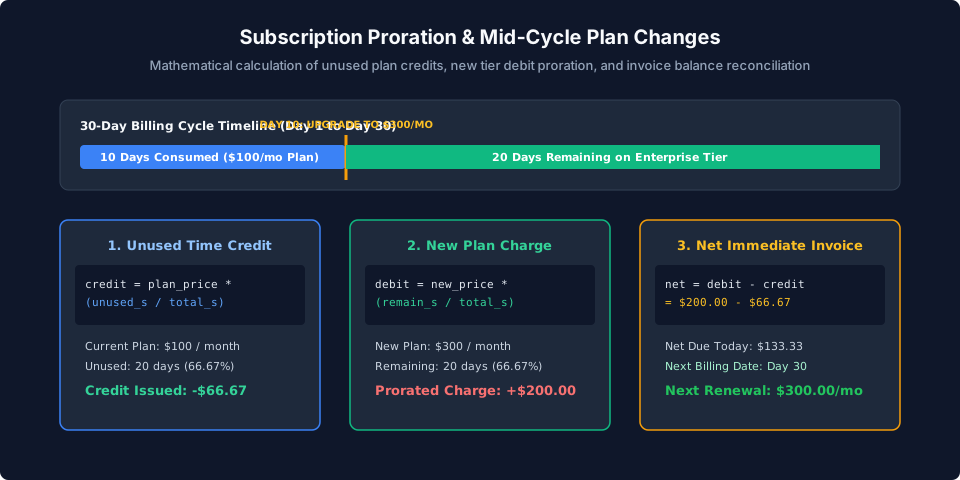
In a self-serve enterprise cloud platform business, customer subscription changes rarely happen on clean monthly boundary dates. A customer on a $100/month Starter plan hires five new engineers on Day 10 and upgrades to the $300/month Pro tier. Three days later, they add an additional user seat; two weeks later, they decide to downgrade back to Starter.
If your billing architecture does not handle mid-cycle proration with mathematical precision, you will trigger severe friction: customers will complain about feeling double-billed, chargebacks will increase, and your finance team will struggle to reconcile deferred revenue under GAAP / IFRS ASC 606.
Proration is the mathematical method of calculating the exact monetary value of unused time on an existing plan and offsetting it against the remaining duration of a new plan. This guide breaks down the second-level calculation mechanics, upgrade versus downgrade workflows, and revenue accounting standards required to handle plan changes smoothly.
The Core Mathematics: Second-Level Proration Precision
Never calculate proration using calendar days. Months vary from 28 to 31 days, and calculating on day boundaries creates rounding errors that generate billing disputes over pennies. Always calculate proration using exact Unix epoch timestamps in seconds.
Let us examine the mathematical formula:
$$\text{Credit (Unused Current Plan)} = \text{Plan Price} \times \left( \frac{T_{\text{period_end}} - T_{\text{change}}}{T_{\text{period_end}} - T_{\text{period_start}}} \right)$$
$$\text{Debit (Remaining New Plan)} = \text{New Plan Price} \times \left( \frac{T_{\text{period_end}} - T_{\text{change}}}{T_{\text{period_end}} - T_{\text{period_start}}} \right)$$
$$\text{Net Amount Due} = \text{Debit} - \text{Credit}$$
Worked Production Scenario: Mid-Cycle Upgrade
Consider a tenant upgrading mid-cycle on a standard 30-day billing period (2,592,000 total seconds):
- Current Plan: Starter ($100.00 / month)
- Period Start: September 1, 00:00:00 UTC
- Period End: October 1, 00:00:00 UTC
- Upgrade Timestamp: September 11, 00:00:00 UTC (10 days elapsed, exactly 20 days remaining)
- New Plan: Pro ($300.00 / month)
- Calculate the Unused Credit:
$$\text{Fraction Remaining} = \frac{20 \text{ days}}{30 \text{ days}} = 0.666667$$
$$\text{Credit} = $100.00 \times 0.666667 = -$66.67$$ - Calculate the Prorated New Plan Charge:
$$\text{Debit} = $300.00 \times 0.666667 = +$200.00$$ - Calculate the Net Immediate Invoice:
$$\text{Net Due Today} = $200.00 - $66.67 = \mathbf{$133.33}$$
The customer pays $133.33 today. On October 1, their subscription renews for the standard Pro price of $300.00/month. The math is transparent, equitable, and completely defensible.
| Action Date | Event | Line Item Description | Amount |
|---|---|---|---|
| Sep 1 | Initial Renewal | Starter Plan (Sep 1 – Oct 1) | +$100.00 |
| Sep 11 | Plan Upgrade | Unused Starter Plan Credit (Sep 11 – Oct 1) | -$66.67 |
| Sep 11 | Plan Upgrade | Remaining Pro Plan Charge (Sep 11 – Oct 1) | +$200.00 |
| Sep 11 | Net Invoice | Amount Charged to Card Immediately | +$133.33 |
| Oct 1 | Next Renewal | Pro Plan Renewal (Oct 1 – Nov 1) | +$300.00 |
Upgrades vs. Downgrades: Asymmetric Workflows
While mathematical formulas work in both directions, business workflows must treat upgrades and downgrades asymmetrically:
1. Plan Upgrades: Immediate Execution
When a customer upgrades:
- Calculate the prorated difference immediately.
- Attempt to charge the customer's credit card on file immediately.
- If the charge succeeds, provision the new tier entitlements in Redis instantly.
- If the card fails, do not activate the upgrade; keep the customer on their existing plan and display an inline card update form.
2. Plan Downgrades: End-of-Cycle Scheduling
When a customer chooses to downgrade from Pro ($300) to Starter ($100) mid-cycle, do not execute an immediate plan change and refund their credit card.
Why? If you downgrade immediately:
- You have to claw back features they may have already used (e.g. deleting team members if their seat count drops).
- Merchant processors charge fees on card refunds, costing you money.
- Immediate refunds create significant accounting complexity.
The cloud platform Best Practice: Schedule the downgrade to occur at the end of the current billing cycle (prorate = false, cancel_at_period_end = true or schedule_update_at_period_end). The customer retains the Pro features they have already paid for through the end of the month, and automatically switches to Starter on the renewal date.
Handling Mid-Cycle Seat Additions
In seat-based cloud platform (charging per active team member), users are added dynamically throughout the month.
There are two architectural methods to handle seat proration:
| Strategy | Mechanism | Pros | Cons |
|---|---|---|---|
| Immediate Invoicing | Charge the card for the prorated seat fraction the moment an invite is accepted | Prevents runaway unpaid seat usage | Can generate dozens of tiny credit card transactions, triggering bank fraud flags |
| Threshold Thresholding / Next-Cycle Invoicing | Accumulate prorated seat charges on the customer balance; bill either when balance reaches $100 or on next monthly renewal | Minimizes credit card transaction fees; clean single monthly invoice | Small credit risk if customer cancels before next renewal |
For enterprise accounts, Next-Cycle Invoicing is preferred because procurement departments strongly dislike receiving multiple unpredictable micro-invoices during the month.
ASC 606 Revenue Recognition Mechanics
Under US GAAP and IFRS ASC 606 (Revenue from Contracts with Customers), cash collection does not equal recognized revenue. You cannot recognize an upfront subscription payment as revenue on the day the credit card is charged.
Revenue must be recognized daily over the performance delivery period:
[ Upfront Cash Collection: $133.33 ]
                 |
                 v
   [ Balance Sheet: Deferred Revenue (Liability) ]
                 |
                 | (Amortized daily: $133.33 / 20 days = $6.67/day)
                 v
   [ Income Statement: Recognized Revenue ]
Annual Contracts with Quarterly Seat Adjustments
In high-value enterprise cloud platform, enterprise customers rarely pay monthly; they sign 1-year or 3-year annual upfront contracts (e.g. $60,000/year for 100 enterprise seats).
When an annual enterprise customer adds 20 seats halfway through the contract year (Month 6):
- Never reset the renewal date: The annual contract renewal date (e.g. January 15) must remain fixed.
- Calculate Fractional Year Proration:
$$\text{Remaining Duration} = \frac{\text{Remaining Seconds until Annual Renewal}}{\text{Total Seconds in Contract Year (31,536,000)}}$$
$$\text{Additional Due} = 20 \text{ seats} \times $600/\text{seat/year} \times \left( \frac{182.5 \text{ days}}{365 \text{ days}} \right) = $6,000.00$$ - True-Up Invoicing: The customer is billed $6,000 immediately, and the subsequent annual renewal automatically scales to 120 seats ($72,000/year).
Multi-Currency Proration and FX Rate Locking
If your cloud platform bills international customers across multiple currencies (USD, EUR, GBP, JPY), proration calculations must navigate currency exchange rate volatility.
Consider a customer who paid €1,000 on September 1 when the EUR/USD exchange rate was 1.10 ($1,100 USD). On September 15, they upgrade to a plan priced in USD ($2,000), but the exchange rate has shifted to 1.08.
The Golden Accounting Rule:
Always calculate proration in the invoice presentment currency of the existing subscription. If the customer's subscription is denominated in EUR, compute their unused credit in EUR before applying the exchange rate active on the day of the upgrade. Once the net invoice is created, lock the exchange rate permanently for that transaction. Never recalculate past proration credits against shifting spot exchange rates retroactively.
Edge Cases: Leap Years, Leap Seconds, and Daylight Savings
Proration calculations implemented with calendar libraries frequently fail on edge cases:
| Edge Case | Failure Mode | Architectural Defense |
|---|---|---|
| Daylight Savings Time (DST) | Clock moves forward/backward by 1 hour; 24-hour day has 23 or 25 hours | Always calculate durations in UTC Unix epoch seconds. UTC does not observe DST |
| Leap Years (Feb 29) | Dividing monthly fee by 28 days during a leap year inflates daily rates | Calculate using exact seconds in the specific billing period: period_end - period_start |
| Micro-Cents Rounding | Multiple seat fractions accumulate fractional cents (e.g. $13.333333) | Store and compute all financial values in the smallest integer unit (cents) using integer math |
Summary Checklist for Production
- Second-Level Accuracy: Calculate proration using exact Unix timestamps (
period_end - change_time) rather than calendar day fractions. - Immediate Charge on Upgrades: Collect prorated funds before provisioning higher-tier features.
- Schedule Downgrades at Period End: Allow customers to enjoy paid tiers through their current cycle rather than issuing cash refunds.
- Lock Foreign Exchange Rates: Perform proration in the base currency and lock FX spot rates upon invoice creation.
- Maintain Fixed Annual Co-Terming: Align mid-cycle seat additions to the original annual contract anniversary date.
- Provide Invoice Previews: Always show an explicit invoice preview (
You will be charged $133.33 today) before the user clicks "Confirm Upgrade". - Account Balance Integration: Store downgrade credits in the customer's account balance to deduct automatically from their next renewal.
Frequently Asked Questions
What happens if a customer downgrades mid-cycle and their credit exceeds their next invoice?
The unused portion remains as a negative balance on the customer account in Stripe or your billing engine. It is automatically drawn down on subsequent renewal invoices until exhausted.
Should mid-cycle plan downgrades take effect immediately or at period end?
The cloud platform industry best practice is to schedule downgrades to take effect at the end of the current billing cycle. This avoids complex clawbacks of consumed quota and eliminates customer confusion.
Why should you avoid immediate credit card refunds for plan downgrades?
Credit card refunds incur non-refundable merchant processing fees and increase payment dispute risks. Applying proration as account credit preserves cash flow while remaining completely fair to the customer.
How do you calculate proration when adding a new user seat mid-month?
Calculate the per-seat monthly rate divided by total seconds in the billing cycle, multiplied by remaining seconds until the cycle renewal date, and invoice the customer immediately or bundle it into the next billing cycle.
How does ASC 606 treat unearned prorated subscription revenue?
Under ASC 606, upfront prorated payments are booked as Deferred Revenue (a balance sheet liability) and amortized into Recognized Revenue daily as the software service is delivered.
Can you disable proration entirely in cloud platform billing?
Yes. Some enterprise cloud platform models prohibit mid-cycle proration, requiring contract amendments or applying all changes strictly on annual anniversary dates. However, self-serve cloud platforms generally require proration for frictionless upgrades.