Designing a Real-Time Usage-Based Metering Pipeline for Cloud Platforms
Architect a high-throughput, idempotent event metering pipeline for consumption billing with Kafka, Redis deduplication, and TimescaleDB rollups.
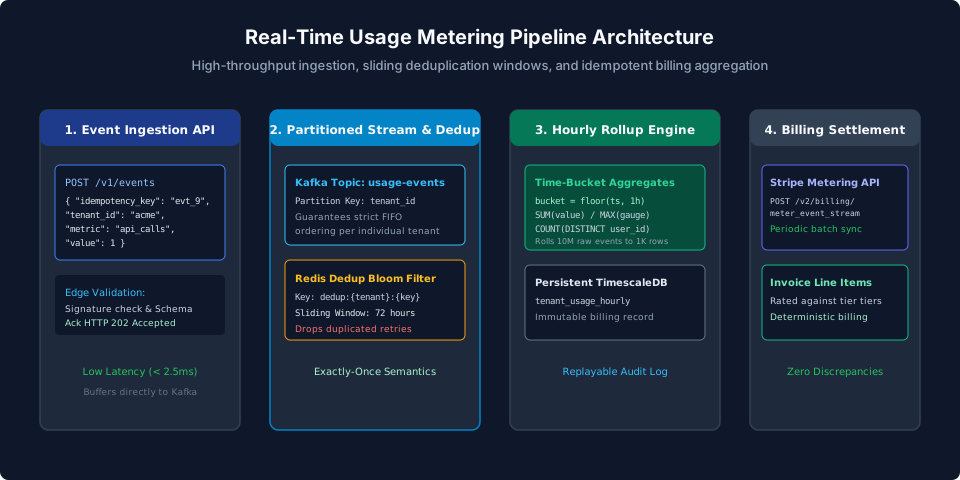
The shift from flat-rate subscription tiers to consumption and usage-based pricing (UBP) is one of the most prominent business transitions in modern enterprise cloud platform. Companies like Snowflake, Twilio, and Stripe have demonstrated that charging customers based on actual value consumed—such as API calls, gigabytes processed, compute seconds, or AI tokens—aligns customer incentives, accelerates initial adoption, and expands net revenue retention.
However, moving to usage-based billing introduces massive backend engineering complexity. Unlike standard monthly subscriptions where you charge a fixed credit card fee on the first of the month, usage-based billing transforms your billing system into a high-throughput, distributed event-processing pipeline. If your pipeline drops events, you leak revenue. If it processes events twice, you over-bill customers and destroy enterprise trust.
To succeed with usage billing, your architecture must achieve exactly-once billing semantics at scale. This guide presents an end-to-end blueprint for building a real-time, fault-tolerant usage metering pipeline using Apache Kafka, Redis deduplication windows, TimescaleDB continuous rollups, and payment gateway settlement.
The Architectural Anatomy of a Metering Pipeline
A production usage metering pipeline consists of four distinct operational stages:
[ Inbound Workload (API Calls, Workers) ]
                    |
           1. Ingestion Boundary
           (HTTP 202; Validate & Deduplicate)
                    v
           2. Partitioned Event Log
           (Kafka Topic: usage-events by tenant_id)
                    v
           3. Hourly Rollup Engine
           (TimescaleDB / ClickHouse Continuous Aggregation)
                    v
           4. Gateway Reconciliation & Invoicing
           (Batch Sync to Stripe Billing / Custom Ledger)
By decoupling raw ingestion from final invoice rating, your core user-facing API remains blazingly fast (< 2ms ingestion latency) while the heavy mathematical rating and discounting occur asynchronously.
Stage 1: High-Throughput Edge Ingestion & Deduplication
When a customer performs a metered action, the application emits a structured meter event. The ingestion endpoint must accept the event, validate its payload against a strict schema, and return HTTP 202 Accepted immediately.
Every meter event must contain four mandatory fields:
tenant_id: The billing account UUID.idempotency_key: A unique client-generated UUID or hash ensuring that network retries do not cause duplicate billing.timestamp: An ISO-8601 UTC timestamp recording when the action actually occurred.metric_nameandvalue: The quantity and unit consumed (e.g.api_queries: 1,storage_bytes: 1048576).
{
  "tenant_id": "c1209b55-89c0-42ab-8c9a-8b8201a4f001",
  "idempotency_key": "evt_2026_09_24_req_99812",
  "metric_name": "ai_inference_tokens",
  "timestamp": "2026-09-24T02:45:10Z",
  "value": 1420,
  "properties": {
    "model": "claude-3-5-sonnet",
    "region": "us-east-1"
  }
}
Sliding Window Deduplication in Redis
Before buffering the event to your message queue, check for duplicates against a sliding time window in Redis. Store incoming idempotency keys in Redis with a 72-hour Time-to-Live (TTL):
func (s *MeteringIngress) IngestEvent(ctx context.Context, evt MeterEvent) error {
	// 1. Build composite deduplication key
	dedupKey := fmt.Sprintf("meter_dedup:%s:%s", evt.TenantID, evt.IdempotencyKey)

	// 2. Atomic SET NX EX (Set if Not Exists with 72-hour TTL)
	set, err := s.rdb.SetNX(ctx, dedupKey, "1", 72*time.Hour).Result()
	if err != nil {
		return fmt.Errorf("redis dedup check failed: %w", err)
	}

	if !set {
		// Event was already processed within the last 72 hours; drop silently as duplicate
		return nil
	}

	// 3. Dispatch to Kafka partitioned by tenant_id
	return s.kafkaProducer.Produce(ctx, "usage-events", evt.TenantID, evt)
}
Stage 2: Partitioning and Stream Processing
When writing events to Apache Kafka or AWS Kinesis, you must specify tenant_id as the message partition key.
Why is this essential? In distributed stream processing, total ordering across all messages is impossible. However, partitioning by tenant_id guarantees that all events belonging to a single customer are processed in strict chronological FIFO order on the same consumer thread. This prevents race conditions where a quota reset event is processed before an invoice finalization event.
Stage 3: Windowed Rollups in TimescaleDB
Storing billions of raw events in a standard relational table causes query timeouts when calculating monthly invoices. To solve this, write events to an append-only hypertable in TimescaleDB (or ClickHouse) and define automated Continuous Aggregates.
Continuous aggregates incrementally compress millions of individual meter events into hourly summaries in the background:
-- 1. Create the base hypertable
CREATE TABLE raw_meter_events (
    time TIMESTAMPTZ NOT NULL,
    tenant_id UUID NOT NULL,
    metric_name TEXT NOT NULL,
    value DOUBLE PRECISION NOT NULL
);

SELECT create_hypertable('raw_meter_events', 'time');

-- 2. Define hourly continuous aggregate view
CREATE MATERIALIZED VIEW tenant_hourly_usage
WITH (timescaledb.continuous) AS
SELECT
    time_bucket('1 hour', time) AS bucket,
    tenant_id,
    metric_name,
    SUM(value) AS total_consumption,
    COUNT(*) AS total_events,
    MAX(value) AS peak_gauge
FROM raw_meter_events
GROUP BY bucket, tenant_id, metric_name;

-- 3. Set automated refresh policy (every 15 minutes)
SELECT add_continuous_aggregate_policy('tenant_hourly_usage',
    start_offset => INTERVAL '3 days',
    end_offset => INTERVAL '15 minutes',
    schedule_interval => INTERVAL '15 minutes');
When an invoice needs to be generated, your billing engine does not scan 10 million raw rows. It executes a query against tenant_hourly_usage, scanning only 720 pre-aggregated hourly rows for the entire month:
SELECT
    metric_name,
    SUM(total_consumption) AS billable_units
FROM tenant_hourly_usage
WHERE tenant_id = 'c1209b55-...'
  AND bucket >= '2026-09-01 00:00:00+00'
  AND bucket <  '2026-10-01 00:00:00+00'
GROUP BY metric_name;
This reduces query latency from 45 seconds to under 8 milliseconds, completely shielding your primary database from billing query loads.
Stage 4: Rating Engine and Gateway Reconciliation
Once billable units are aggregated, the Rating Engine calculates the final monetary amount due based on the customer's subscription contract.
Common rating models include:
- Tiered Volume Pricing: $0.01 per unit for the first 10,000 units; $0.008 for units 10,001 to 50,000.
- Overages on Base Allowances: 50,000 included units per month; $0.05 per unit thereafter.
- Peak Resource Gauges: Billed on the highest concurrent active seats recorded during any hour of the month.
Syncing to Payment Gateways (Stripe Billing)
Once the period closes and allowable late-arrival windows pass (typically 24 hours after the month ends), sync the aggregated units to Stripe's Metering API:
func SyncToStripe(ctx context.Context, stripeClient *stripe.Client, tenantID string, metric string, units int64) error {
	params := &stripe.BillingMeterEventParams{
		EventName: stripe.String(metric),
		Payload: map[string]string{
			"stripe_customer_id": GetStripeCustomerID(tenantID),
			"value":              strconv.FormatInt(units, 10),
		},
		Timestamp: stripe.Int64(time.Now().Unix()),
	}

	_, err := stripeClient.BillingMeterEvents.New(params)
	return err
}
Handling Edge Cases: Clock Skew and Disputes
| Edge Case Challenge | Failure Mode | Architectural Defense |
|---|---|---|
| Client Clock Skew | Device timestamp is 3 months in the past or future | Reject events whose timestamp differs from server ingestion time by more than 24 hours |
| Late-Arriving Events | Disconnected IoT devices send 5 days of usage after month end | Allow a 48-hour settlement window; excess usage rolls into next month's invoice as an adjustment |
| Customer Audit Disputes | Enterprise customer contests an unexpected $25,000 invoice | Maintain raw event cold archives in S3/Parquet for 7 years to regenerate deterministic proof |
Practical Next Steps
- Standardize Event Schemas: Define a canonical JSON schema for all meter events, enforcing strict validation at your HTTP ingestion proxy.
- Deploy Redis Deduplication: Implement the 72-hour
SET NX EXpattern on all event ingestion endpoints. - Partition by Tenant: Ensure your Kafka, SQS, or RabbitMQ queue configuration uses
tenant_idas the message grouping key. - Implement Hourly Materialized Rollups: Migrate raw event aggregation to TimescaleDB or ClickHouse continuous aggregates.
Frequently Asked Questions
How do you handle late-arriving usage events that belong to a closed billing cycle?
Establish an allowable settlement grace window (typically 24 to 48 hours after period end). Events arriving after the final invoice has been finalized are aggregated as an adjustment line item on the subsequent billing cycle.
Can we send raw usage events directly to Stripe's Metering API on every user action?
No. Sending an external HTTP request to Stripe on every single user API call adds intolerable latency and exposes your application to third-party rate limits. You must aggregate events locally and batch sync them to Stripe periodically.
How do you prevent duplicate charges if a client retries a failed network request?
Enforce a unique composite idempotency constraint on (tenant_id, idempotency_key). Store seen keys in Redis with a 72-hour TTL to reject duplicates atomically at the ingestion boundary.
What is the difference between a gauge metric and an incremental counter metric in metering?
A counter metric sums discrete actions over time (e.g. total API calls, GB data processed). A gauge metric tracks concurrent resource consumption at specific points in time (e.g. peak active seats, current storage allocated).
How do you test metering accuracy before releasing a new pricing plan?
Run historical backfills by replaying past event streams through the new pricing rating engine in shadow mode, comparing the simulated invoices against actual customer usage patterns.
What database engine is best suited for storing raw usage metrics?
Time-series extensions on PostgreSQL like TimescaleDB, or distributed analytical engines like ClickHouse, provide hypertable partitioning, compression ratios exceeding 90%, and fast SQL rollups.