Row-Level Security in PostgreSQL: Implementing Safe Multi-Tenant Isolation
A deep technical guide to configuring PostgreSQL Row-Level Security (RLS) policies, session variable hygiene, and composite index tuning for cloud platform.
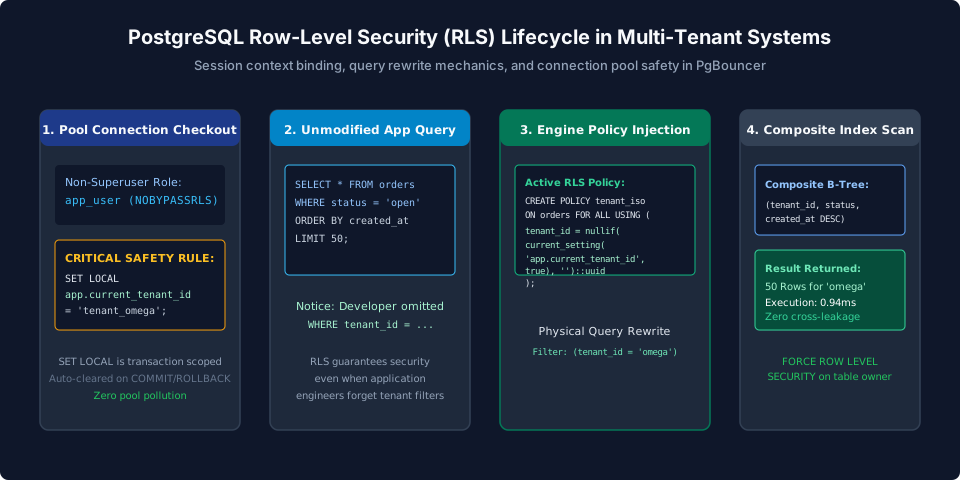
For engineering teams building multi-tenant cloud systems applications, the greatest persistent terror is a cross-tenant data leak. If you rely solely on application developers remembering to append WHERE tenant_id = ? to every SQL query, an eventual mistake is mathematically inevitable. A single missed filter in an ORM query, a sloppy analytics report, or an ambiguous database view will expose one customer's private financial records to another.
PostgreSQL Row-Level Security (RLS) solves this problem by moving tenant boundary enforcement from fragile application code directly into the database engine kernel. When RLS is configured correctly, PostgreSQL automatically rewrites every SELECT, UPDATE, and DELETE query to restrict access to rows belonging to the active tenant session, regardless of what query text your application sends.
However, implementing RLS in high-throughput production systems requires precision. Improper connection pool management can cause tenant identities to bleed between pooled connections, while un-indexed tenant filters will degrade query execution into full table scans. This guide provides a complete blueprint for architecting, benchmarking, and maintaining production PostgreSQL Row-Level Security.
The Anatomy of an RLS Policy: USING vs. WITH CHECK
When you enable RLS on a table, PostgreSQL defaults to a "deny all" security posture. You must create explicit policies defining what rows can be accessed.
An RLS policy contains two key clauses:
- The
USINGClause: Controls which existing rows are visible forSELECT,UPDATE, andDELETEoperations. If a row evaluates tofalseorNULL, PostgreSQL acts as if the row simply does not exist. - The
WITH CHECKClause: Controls which new or modified rows are permitted duringINSERTandUPDATEoperations. If a modified row fails theWITH CHECKexpression, PostgreSQL aborts the entire transaction with an error.
Here is the definitive multi-tenant policy template:
-- 1. Enable RLS on the multi-tenant table
ALTER TABLE documents ENABLE ROW LEVEL SECURITY;

-- 2. MANDATORY: Force RLS even for the table owner
ALTER TABLE documents FORCE ROW LEVEL SECURITY;

-- 3. Define the comprehensive tenant policy
CREATE POLICY tenant_isolation_policy ON documents
    FOR ALL
    USING (
        tenant_id = NULLIF(current_setting('app.current_tenant_id', true), '')::UUID
    )
    WITH CHECK (
        tenant_id = NULLIF(current_setting('app.current_tenant_id', true), '')::UUID
    );
The Purpose of NULLIF(..., true)
Notice the arguments to current_setting:
- Setting the second parameter to
true(current_setting('app.current_tenant_id', true)) instructs PostgreSQL to returnNULLinstead of throwing a fatal error if the session variable has not been initialized. - Wrapping the result in
NULLIF(..., '')converts empty strings toNULL. - In SQL logic,
tenant_id = NULLalways evaluates toUNKNOWN(falsy). Therefore, if a developer checks out a database connection without setting a tenant ID, zero rows are returned and zero rows can be written. The system fails closed safely by default.
The Connection Pool Hazard: SET LOCAL vs. SET
In a modern web architecture, application servers do not establish a raw TCP connection for each request; they check out connections from a pool managed by PgBouncer or an internal backend connection pool.
If you set your tenant variable using standard SET:
-- DANGEROUS IN CONNECTION POOLING!
SET app.current_tenant_id = 'c1209b55-...';
SELECT * FROM documents;
The session variable persists on that physical connection indefinitely. When the connection is returned to the pool and checked out by a subsequent request belonging to a completely different company, that connection will inherit the previous tenant's identity if the next handler fails to overwrite it.
The Solution: Transaction-Scoped SET LOCAL
Always execute multi-tenant queries within an explicit SQL transaction using SET LOCAL:
BEGIN;
-- Scoped strictly to this transaction block:
SET LOCAL app.current_tenant_id = 'c1209b55-...';

SELECT * FROM documents; -- Securely isolated to c1209b55

COMMIT; -- Variable is automatically erased from the connection!
When the transaction completes (COMMIT or ROLLBACK), PostgreSQL immediately clears app.current_tenant_id. The connection returned to PgBouncer is entirely neutral.
// Safe database transaction execution wrapper
func WithTenantTx(ctx context.Context, db *sql.DB, tenantID string, fn func(tx *sql.Tx) error) error {
	tx, err := db.BeginTx(ctx, nil)
	if err != nil {
		return err
	}
	defer tx.Rollback()

	// Bind tenant context for the duration of this transaction only
	setQuery := fmt.Sprintf("SET LOCAL app.current_tenant_id = '%s';", tenantID)
	if _, err := tx.ExecContext(ctx, setQuery); err != nil {
		return fmt.Errorf("setting tenant context: %w", err)
	}

	if err := fn(tx); err != nil {
		return err
	}

	return tx.Commit()
}
Performance Benchmarking and Index Tuning
A common misconception is that Row-Level Security causes major performance penalties. In reality, RLS merely instructs the PostgreSQL query planner to inject an additional WHERE tenant_id = ... predicate into the abstract syntax tree before generating the execution plan.
The difference between lightning-fast performance and a database meltdown comes down to index design.
Composite B-Tree Index Rules
Every index on an RLS-protected table must place tenant_id as the leftmost column.
-- BAD: Postgres must scan the entire index, filtering out rows tenant by tenant
CREATE INDEX idx_orders_status ON orders (status, created_at DESC);

-- EXCELLENT: Postgres seeks directly to the tenant's subtree in 0.02ms
CREATE INDEX idx_orders_tenant_status ON orders (tenant_id, status, created_at DESC);
Let us examine the actual EXPLAIN ANALYZE output on a table with 25 million rows:
EXPLAIN ANALYZE SELECT * FROM orders WHERE status = 'shipped' ORDER BY created_at DESC LIMIT 20;

-- With Proper Composite Index (tenant_id, status, created_at DESC):
-- -> Limit (cost=0.43..12.50 rows=20 width=84) (actual time=0.035..0.082 rows=20 loops=1)
--    -> Index Scan using idx_orders_tenant_status on orders (cost=0.43..480.20 rows=800 width=84)
--       Index Cond: ((tenant_id = 'c1209b55...'::uuid) AND (status = 'shipped'::text))
-- Planning Time: 0.142 ms
-- Execution Time: 0.098 ms
Because tenant_id is the leading index key, PostgreSQL performs an instant B-tree seek. The RLS filter adds zero measurable latency.
| Query Pattern | Index Structure | Planning Time | Execution Time | Production Risk |
|---|---|---|---|---|
| RLS with Leading Tenant Index | (tenant_id, col_a, col_b) |
0.15ms | 0.09ms | None: Instant index seek |
| RLS with Trailing Tenant Index | (col_a, col_b, tenant_id) |
0.18ms | 14.5ms | Medium: Scans multiple tenants' index pages |
| RLS without Tenant Index | (col_a) |
0.22ms | 850.0ms | Critical: Triggers sequential scan across all millions of rows |
The Critical Role of FORCE ROW LEVEL SECURITY
In standard PostgreSQL behavior, table owners and superusers are exempt from RLS policies. By default, if your application connects using the database role that created the tables (the table owner), PostgreSQL silently disables RLS, exposing all tenant records!
To prevent this catastrophic failure, you must always run:
ALTER TABLE documents FORCE ROW LEVEL SECURITY;
FORCE ROW LEVEL SECURITY guarantees that even if the connection user owns the table, policies are strictly evaluated. The only role that can bypass a forced RLS table is a role explicitly granted SUPERUSER or BYPASSRLS.
Summary Checklist for Production RLS
- Role Hygiene: Create an unprivileged
app_userrole withoutSUPERUSERorBYPASSRLSprivileges. - Force RLS on Every Table: Execute
ALTER TABLE <name> FORCE ROW LEVEL SECURITY;on all multi-tenant entities. - Strict Session Scoping: Always use
SET LOCAL app.current_tenant_idinside explicitBEGIN ... COMMITtransaction blocks. - Composite Index Audit: Verify that
tenant_idis the leftmost column on every compound index. - Automated CI Tests: Write integration tests verifying that querying the database without setting
app.current_tenant_idreturns zero rows.
Frequently Asked Questions
Can Row-Level Security be bypassed if a developer forgets to set app.current_tenant_id?
If NULLIF(current_setting('app.current_tenant_id', true), '') evaluates to NULL, the comparison `tenant_id = NULL` returns FALSE for all rows in standard SQL. An unset tenant variable results in an empty dataset, failing closed safely.
How does RLS interact with connection poolers like PgBouncer in transaction mode?
Using `SET LOCAL` guarantees that the variable resets immediately when the transaction completes (COMMIT or ROLLBACK). The connection returned to the PgBouncer pool is clean, preventing subsequent requests from inheriting the previous tenant's identity.
Does RLS slow down bulk INSERT operations?
For INSERT operations, the WITH CHECK clause evaluates the tenant_id on the new rows. When inserting thousands of rows, RLS adds approximately 2% to 4% CPU overhead compared to an unrestricted table, which is negligible for standard transactional workloads.
Why is FORCE ROW LEVEL SECURITY necessary if ENABLE ROW LEVEL SECURITY is already turned on?
By default in PostgreSQL, table owners and superusers bypass RLS policies even if enabled. FORCE ROW LEVEL SECURITY explicitly mandates that policies apply to the table owner as well, closing a critical security loophole.
How do you run administrative cross-tenant analytical queries when RLS is enabled?
Create a dedicated analytical database role (e.g., `analytics_user`) granted the `BYPASSRLS` attribute. This role should only be accessible from your internal ETL pipeline or business intelligence servers, completely separated from web application credentials.
What is the optimal index structure for a table protected by RLS?
Every index on an RLS-enabled table should be a composite index with tenant_id as the very first column (e.g. `CREATE INDEX ON orders (tenant_id, created_at DESC)`). This allows the planner to satisfy the RLS predicate and user sort order in a single index scan.