Database-per-Tenant vs. Shared Schema: Choosing a Data Isolation Architecture
Compare database-per-tenant, schema-per-tenant, and shared table architectures to choose the right data isolation model for your cloud software platform.
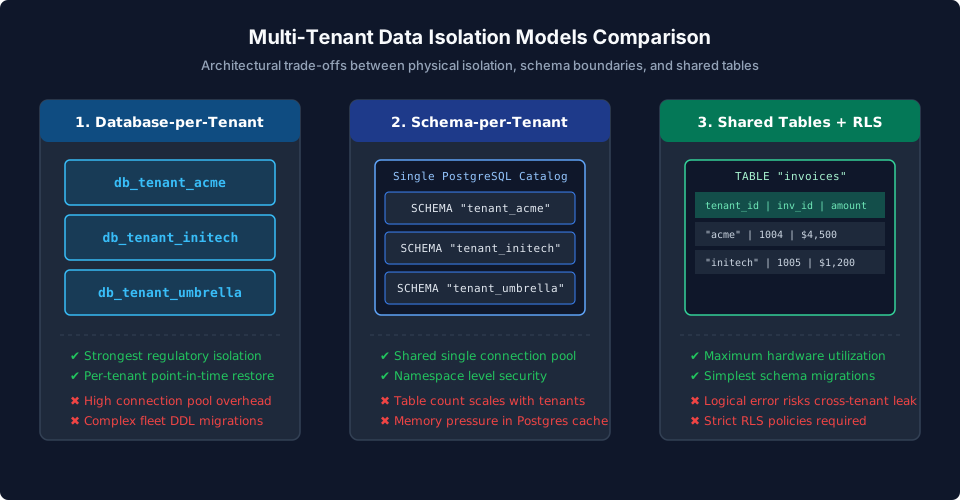
When you design the database architecture for a multi-tenant enterprise cloud platform application, the choice of data isolation determines your operating margins, compliance ceiling, and engineering velocity for years. If you choose an isolation model that is too loose, an un-scoped database query can leak confidential enterprise records to a competitor, destroying customer trust in minutes. If you choose a model that is too rigid, infrastructure costs and database connection overhead will overwhelm your server cluster before your revenue scales.
The short answer is that no single isolation model suits every customer stage. Most successful enterprise cloud platforms adopt a hybrid isolation tiering model: free, starter, and mid-market accounts share common database tables protected by PostgreSQL Row-Level Security (RLS), while top-tier enterprise customers with strict regulatory mandates are provisioned dedicated databases. This guide breaks down the concrete trade-offs between physical databases, schema separation, and shared tables so you can make an informed choice for your workload.
The Core Dilemma of multi-tenant data Isolation
Every multi-tenant application must answer one fundamental architectural question: at what layer of the technology stack do you enforce the boundary between customer data?
You can isolate data at three distinct layers:
- The Infrastructure Layer (Physical): Each tenant has a completely separate database cluster or standalone database catalog.
- The Namespace Layer (Logical): Tenants share an operating database cluster and catalog, but store tables inside isolated schemas (
CREATE SCHEMA tenant_acme). - The Row Layer (Software/Kernel): Tenants share the same tables, where every record contains a foreign key
tenant_id, and isolation is enforced by software filters or database kernel policies.
The choice represents a fundamental trade-off between operational complexity and data boundary certainty. Physical isolation makes cross-tenant data leaks impossible at the storage layer, but it multiplies the number of database objects you must maintain, backup, and connect to. Shared tables minimize hardware overhead and simplify database migrations, but they demand rigorous software safeguards to prevent accidental data leaks.
Model 1: Database-per-Tenant (The Silo Pattern)
In the database-per-tenant model, your application connects to a distinct database instance or catalog for each registered organization. If you have 300 customers, your fleet operates 300 independent databases (db_tenant_acme, db_tenant_initech, db_tenant_umbrella).
Key Operational Advantages
The primary benefit of physical separation is regulatory peace of mind. When an enterprise security officer asks how you ensure their data is not co-mingled with other companies, pointing to separate database files on encrypted storage volumes satisfies the most conservative compliance audits (such as FedRAMP High, PCI-DSS Level 1, or European banking mandates).
Physical isolation also grants you per-tenant point-in-time recovery (PITR). If Tenant A mistakenly runs a bulk script that corrupts all their customer records at 14:00, you can restore Tenant A's database to 13:59 from write-ahead logs (WAL) without affecting Tenant B or Tenant C. Furthermore, noisy neighbor queries from one tenant cannot saturate disk I/O or lock tables in another tenant's database.
The Hidden Connection Pool Bottleneck
The fatal flaw of the database-per-tenant pattern in high-growth cloud platform is connection pooling exhaustion. In PostgreSQL, every backend worker process consumes between 5MB and 10MB of server memory, even when idle. Connection poolers like PgBouncer maintain discrete connection pools per database catalog.
If you have 1,000 tenants, and your application servers maintain a modest minimum pool of 5 connections per database across 3 web replicas, your cluster requires:
1,000 tenants * 5 connections * 3 app servers = 15,000 PostgreSQL backend connections
A standard PostgreSQL cluster will collapse under the memory weight and context-switching overhead of 15,000 backend connections. To run database-per-tenant at scale, you must deploy dynamic proxy fleets (such as AWS RDS Proxy or custom Envoy connection routers) that dynamically spin up and tear down idle database connections, adding operational cost and network latency.
| Architectural Dimension | Database-per-Tenant | Production Limitation |
|---|---|---|
| Data Leak Risk | Physically impossible via SQL query error | High operational risk of routing request to wrong database string |
| Connection Pooling | Separate connection pool per database | Server RAM exhaustion when database count exceeds ~500 |
| Schema Migrations | Sequential loop across N database catalogs | Long deployment windows; partial failure leaves fleet out of sync |
| Point-in-Time Restore | Independent per tenant | High storage cost for thousands of discrete snapshot schedules |
| Hardware Efficiency | Low (many idle pools and underutilized RAM) | High cloud hosting costs per low-activity tenant |
Model 2: Schema-per-Tenant (The Namespace Pattern)
Schema-per-tenant represents a middle tier. You operate a single PostgreSQL database catalog, but create an isolated namespace for each tenant:
CREATE SCHEMA tenant_acme;
CREATE TABLE tenant_acme.users (...);
CREATE TABLE tenant_acme.invoices (...);

CREATE SCHEMA tenant_initech;
CREATE TABLE tenant_initech.users (...);
CREATE TABLE tenant_initech.invoices (...);
When an incoming HTTP request is authenticated, your application middleware sets the PostgreSQL search path for that transaction:
SET LOCAL search_path TO tenant_acme, public;
Subsequent queries like SELECT * FROM invoices; automatically resolve to tenant_acme.invoices.
The Catalog Cache Memory Trap
While schema-per-tenant solves the connection pool problem (because all schemas share the same database connection pool), it introduces a severe relational metadata bottleneck.
PostgreSQL caches table definitions, index metadata, and column types in a shared memory region known as the relcache. In a cloud platform with 80 tables and 20 indexes:
- 10 tenants = 800 tables + 200 indexes = 1,000 relations.
- 1,000 tenants = 80,000 tables + 20,000 indexes = 100,000 relations.
When PostgreSQL manages over 50,000 relations, routine DDL commands, foreign key validations, and query planning slow down dramatically. Furthermore, the PostgreSQL autovacuum daemon must scan tens of thousands of individual tables, creating significant catalog disk churn and increasing the risk of transaction ID (XID) wraparound failure.
| Architectural Dimension | Schema-per-Tenant | Production Limitation |
|---|---|---|
| Connection Sharing | All schemas share standard connection pool | Application must remember to set search_path on every checkout |
| Metadata Overhead | High catalog relation count | Relcache memory pressure slows down query planner above 500 tenants |
| DDL Migrations | Parallel schema migrations possible | Fleet migrations require looping through thousands of schemas |
| Cross-Tenant Leaks | Low, protected by schema search path | Search path pollution in connection pools if SET LOCAL is omitted |
Model 3: Shared Database, Shared Table (The Pool Pattern)
In the shared table model, all tenants share identical database tables. Every multi-tenant table includes a mandatory discriminator column, typically named tenant_id:
CREATE TABLE invoices (
    id UUID PRIMARY KEY DEFAULT gen_random_uuid(),
    tenant_id UUID NOT NULL REFERENCES tenants(id),
    customer_name TEXT NOT NULL,
    amount_cents BIGINT NOT NULL,
    status TEXT NOT NULL,
    created_at TIMESTAMPTZ NOT NULL DEFAULT NOW()
);

-- Essential composite index starting with tenant_id
CREATE INDEX idx_invoices_tenant_status ON invoices (tenant_id, status, created_at DESC);
Enforcing Boundaries with PostgreSQL Row-Level Security
Historically, the shared table pattern terrified security auditors because a single junior developer forgetting a WHERE tenant_id = ? clause could expose financial records across companies.
Modern PostgreSQL eliminates this risk through kernel-level Row-Level Security (RLS). With RLS enabled, PostgreSQL automatically rewrites every query executed on the database connection to append the tenant constraint, regardless of what SQL was submitted by the application:
-- Enable RLS on the table
ALTER TABLE invoices ENABLE ROW LEVEL SECURITY;
ALTER TABLE invoices FORCE ROW LEVEL SECURITY;

-- Define tenant isolation policy
CREATE POLICY tenant_isolation_policy ON invoices
    FOR ALL
    USING (tenant_id = NULLIF(current_setting('app.current_tenant_id', true), '')::UUID);
Before your application executes queries on a checked-out connection, it sets the session variable within the active transaction:
BEGIN;
SET LOCAL app.current_tenant_id = 'c1209b55-89c0-42ab-8c9a-8b8201a4f001';

-- Even if the application developer writes this:
SELECT * FROM invoices WHERE status = 'unpaid';

-- PostgreSQL automatically executes this:
-- SELECT * FROM invoices WHERE status = 'unpaid' AND tenant_id = 'c1209b55...';
COMMIT;
Performance and Scale Benchmarks
When composite indexes are configured properly, the overhead of Row-Level Security is virtually unmeasurable. Because the index starts with tenant_id, the query engine performs a rapid B-tree index jump directly to that tenant's records.
Hardware utilization is maximized: 100% of memory and CPU is shared dynamically among active users. A startup can run thousands of active tenants on a single modest database instance, keeping infrastructure Cost of Goods Sold (COGS) under 3% of revenue.
| Architectural Dimension | Shared Tables with RLS | Production Limitation |
|---|---|---|
| Hardware Efficiency | Optimal; 100% shared resource pooling | High-activity tenants can consume shared I/O if unthrottled |
| Schema Migrations | Single migration runs once for all tenants | Large table size requires zero-downtime DDL techniques |
| Leak Prevention | Enforced at database engine level | Requires dedicated non-superuser role without BYPASSRLS |
| Point-in-Time Restore | Entire cluster restores together | Restoring a single tenant requires extracting records from backup |
Comprehensive Decision Matrix
Use this decision matrix to evaluate which architecture matches your current organization and business requirements:
| Evaluation Criteria | Database-per-Tenant | Schema-per-Tenant | Shared Table + RLS |
|---|---|---|---|
| Target Customer Profile | Regulated Enterprise / Government | Mid-Market Enterprise | Self-Serve / SMB / Mid-Market |
| Average Contract Value | > $50,000 / year | $10,000 - $50,000 / year | < $10,000 / year |
| Max Practical Tenants | 500 - 1,000 per cluster | 300 - 800 per cluster | 100,000+ per cluster |
| Connection Pooling Tool | RDS Proxy / Custom Router | Standard PgBouncer | Standard PgBouncer |
| Migration Complexity | High (fleet orchestration required) | High (schema looping required) | Low (standard single migration) |
| Single-Tenant Backup Restore | Native file/WAL restore | pg_dump / pg_restore schema | Custom application extraction |
| Infrastructure Cost per Tenant | High ($50 - $200 / month) | Medium ($5 - $20 / month) | Negligible (< $0.05 / month) |
The Pragmatic Architecture: The Hybrid Tiering Model
Rather than forcing your entire business into a single extreme, modern cloud architecture separates customer tiers at the infrastructure level:
[ Inbound Application Request ]
               |
      [ Tenant Routing Layer ]
               |
    +----------+----------+
    |                     |
[ Standard Tier ]   [ Enterprise Tier ]
    |                     |
Shared Database     Dedicated Database
(PostgreSQL RLS)    (Isolated VPC / Cluster)
- The Shared Pool Tier (Standard Customers): All free, trial, and standard paying customers live in a high-availability shared PostgreSQL database protected by Row-Level Security. This keeps customer acquisition costs and hosting COGS extremely low.
- The Dedicated Silo Tier (Enterprise Customers): Enterprise accounts paying six-figure annual contracts receive an isolated database instance in a customer-chosen cloud region, complete with custom retention policies, dedicated connection pools, and customer-managed encryption keys.
Your application code remains identical across both tiers: an abstracted database resolver simply looks up the connection string for the tenant ID and connects to either the shared pool or the dedicated instance.
Practical Next Steps for Your Architecture
To implement a reliable multi-tenant database foundation, take these concrete steps:
- Verify Your PostgreSQL Roles: Ensure your application connects to the database as a dedicated application role (e.g.
app_user). Verify with\duthat this role does not have theSUPERUSERorBYPASSRLSattribute. - Mandate Transaction-Scoped Context: Always use
SET LOCAL app.current_tenant_id = ...inside explicit SQL transactions. Using non-localSETcauses session contamination in connection poolers. - Index by Discriminator First: Review your database indexes. Ensure every compound index on multi-tenant tables places
tenant_idas the leftmost column. - Implement Canary Query Testing: Configure automated end-to-end integration tests that deliberately attempt cross-tenant queries, verifying that the database engine rejects unauthorized access attempts.
Frequently Asked Questions
When should an early-stage cloud platform switch from a shared schema to separate databases?
You should switch only when an enterprise customer makes physical isolation a mandatory condition of a high-value contract, or when your compliance requirements (such as FedRAMP High or specific healthcare mandates) legally prohibit shared storage media.
Can PgBouncer handle connection pooling across thousands of separate databases?
No. PgBouncer maintains distinct pool state per database name. When you exceed roughly 500 to 1,000 separate databases, the connection overhead, memory fragmentation, and idle backend sockets overwhelm server memory, requiring proxy fleets like Envoy or RDS Proxy.
How does schema-per-tenant impact PostgreSQL autovacuum performance?
Autovacuum works on a per-table basis. Having 1,000 tenants with 50 tables each creates 50,000 tables. Autovacuum workers spend excessive cycles scanning the catalog and locking metadata, leading to transaction ID wraparound risks if autovacuum workers are under-provisioned.
Is Row-Level Security (RLS) fast enough for high-throughput cloud platform APIs?
Yes. When composite B-tree indexes start with the tenant_id column, PostgreSQL query planner incorporates the RLS predicate directly into the index scan, adding less than 0.1 milliseconds of overhead compared to manual WHERE clauses.
How do you handle cross-tenant analytics in a database-per-tenant setup?
You cannot run simple SQL JOINs across physical databases. You must stream Change Data Capture (CDC) events via Debezium or logical replication into a centralized data warehouse (such as Snowflake or ClickHouse) for aggregate reporting.
What is the recommended migration path when an existing customer upgrades to a dedicated database?
Use PostgreSQL logical replication with row filtering to replicate that specific tenant's records into a fresh database while the application runs, then execute a 5-second connection cutover during off-peak hours.