Preventing Cross-Tenant Data Leaks: Architectural Controls and Automated Audits
A comprehensive guide to building defense-in-depth isolation controls, CI/CD static SQL query linters, and synthetic canary tests in multi-tenant cloud systems.
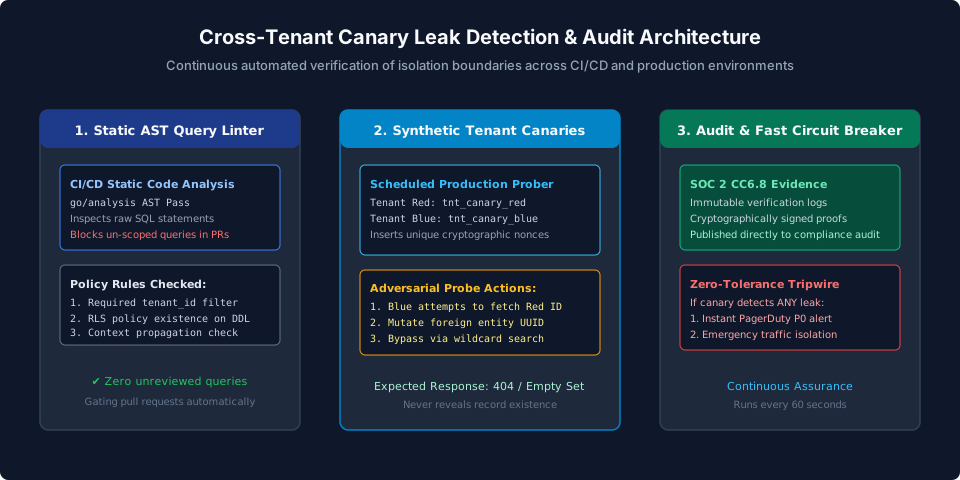
In a multi-tenant cloud systems business, a data breach involving cross-tenant information exposure is an existential disaster. Beyond immediate regulatory penalties under GDPR and HIPAA, customer churn following a publicly confirmed leak can reach 40% within weeks. Enterprise buyers do not forgive platform vendors whose software allows a competitor to view their confidential sales pipeline, proprietary code, or employee records.
Relying on a single mechanism—such as a developer remembering an SQL WHERE clause or an ORM global scope—violates the primary principle of information security: defense-in-depth. If your sole barrier fails, you have zero secondary safeguards to catch the breach before data reaches the browser.
A resilient cloud platform must implement a three-tiered defense:
- Static Prevention: Automated Abstract Syntax Tree (AST) linters in your CI/CD pipeline that block un-scoped queries before deployment.
- Database Engine Enforcement: PostgreSQL Row-Level Security (RLS) that guarantees isolation at the kernel level.
- Continuous Synthetic Auditing: Active canary probers that simulate adversarial cross-tenant attacks in production every 60 seconds.
This guide details how to build and maintain this multi-layered isolation architecture.
The Defense-in-Depth Layered Architecture
To guarantee isolation, every request must pass through three distinct enforcement boundaries:
[ Inbound Client Request ]
           |
  Layer 1: Network & Ingress
  (Strip X-Tenant headers; validate domain ownership)
           |
  Layer 2: Application Middleware
  (Inject authenticated context; AST-verified SQL queries)
           |
  Layer 3: Database Engine Kernel
  (PostgreSQL RLS with FORCE ROW LEVEL SECURITY)
           |
[ Isolated Tenant Records ]
If a developer introduces a bug in Layer 2 by writing SELECT * FROM invoices WHERE id = ?, Layer 3 (PostgreSQL RLS) automatically intercepts the execution and restricts the result to the caller's tenant_id. Conversely, if someone temporarily bypasses RLS during an administrative maintenance script, Layer 2 continues to enforce strict application scoping. Neither layer relies blindly on the other.
Static Analysis: Building an AST Query Linter
The most cost-effective time to prevent a cross-tenant leak is before code merges into your production branch. You can enforce this using custom AST static analysis tools to inspect your codebase's Abstract Syntax Tree during CI.
The custom linter checks that:
- Every SQL query against a multi-tenant table passes an explicit
tenant_idparameter or wraps execution in a verifiedWithTenantTxhelper. - Database queries never bypass context propagation by calling raw
db.Queryinstead ofdb.QueryContext.
package tenantlint

import (
	"go/ast"
	"strings"
	"golang.org/x/tools/go/analysis"
)

var Analyzer = &analysis.Analyzer{
	Name: "tenantlint",
	Doc:  "Verifies that multi-tenant database queries bind tenant context",
	Run:  run,
}

var multiTenantTables = []string{"invoices", "documents", "users", "api_keys", "audit_logs"}

func run(pass *analysis.Pass) (interface{}, error) {
	for _, file := range pass.Files {
		ast.Inspect(file, func(n ast.Node) bool {
			call, ok := n.(*ast.CallExpr)
			if !ok {
				return true
			}

			// Check calls to db.ExecContext or db.QueryContext
			for _, table := range multiTenantTables {
				for _, arg := range call.Args {
					lit, ok := arg.(*ast.BasicLit)
					if ok && strings.Contains(strings.ToLower(lit.Value), table) {
						// Ensure query explicitly mentions tenant_id
						if !strings.Contains(strings.ToLower(lit.Value), "tenant_id") {
							pass.Reportf(lit.Pos(), "Query on multi-tenant table '%s' missing explicit tenant_id filter", table)
						}
					}
				}
			}
			return true
		})
	}
	return nil, nil
}
When an engineer opens a pull request containing an un-scoped query, the CI build fails instantly, providing line-number feedback before the code ever reaches staging.
Continuous Production Verification: Synthetic Canaries
Static analysis and automated unit tests verify your code in isolation, but they cannot catch runtime infrastructure drift: an operator running a bad migration that drops an RLS policy, or a connection pool misconfiguration that disables session variables.
To guarantee that your production environment remains strictly isolated 24/7/365, deploy Synthetic Tenant Canaries.
The Tenant Red / Tenant Blue Probing Model
Your monitoring system registers two automated, synthetic tenant workspaces in production:
- Tenant Red (
tnt_canary_red) - Tenant Blue (
tnt_canary_blue)
Every 60 seconds, an independent prober job executes the following adversarial test cycle:
[ Canary Prober Job (Every 60s) ]
              |
1. Insert secret nonce as Tenant Red:
   doc_id = "doc_8841", secret = "nonce_91a0f8"
              |
2. Authenticate as Tenant Blue (Competitor)
              |
3. Attempt adversarial actions:
   a. GET /api/v1/documents/doc_8841
   b. PATCH /api/v1/documents/doc_8841 (Modify)
   c. DELETE /api/v1/documents/doc_8841 (Delete)
   d. Search /api/v1/documents?q=nonce_91a0f8
              |
4. ASSERTION:
   All Blue requests MUST return HTTP 404 Not Found!
   If ANY request returns 200, 403, or exposes nonce:
   TRIP EMERGENCY CIRCUIT BREAKER (P0 ALERT)
              |
5. Cleanup: Tenant Red deletes doc_8841
Why Assert HTTP 404 Instead of HTTP 403?
Many developers mistakenly return HTTP 403 Forbidden when a tenant requests another company's record. This is a severe information leak known as Resource Enumeration:
- If
GET /invoices/1004returns403 Forbidden, the attacker confirms that Invoice #1004 exists and belongs to someone else. - If
GET /invoices/1005returns404 Not Found, the attacker confirms Invoice #1005 does not exist.
By observing status codes, an attacker can enumerate your entire customer invoice database. In contrast, returning HTTP 404 Not Found completely conceals the record's existence, failing closed and denying information to attackers.
| Response Code | Meaning to Attacker | Security Implication |
|---|---|---|
| HTTP 200 OK | Full data disclosure | Catastrophic breach: Direct data leak |
| HTTP 403 Forbidden | "This record exists, but you lack permission" | Information leak: Confirms entity existence |
| HTTP 404 Not Found | "This record does not exist in your account" | Secure: Total zero-knowledge boundary |
Automated Audit Evidence for SOC 2 and HIPAA
When preparing for a SOC 2 Type II audit under Common Criteria CC6.8 (Logical Separation of Data) or HIPAA Security Rule § 164.312(a)(1) (Access Controls), auditors require tangible proof that your multi-tenant isolation mechanisms functioned continuously throughout the 12-month audit window.
Instead of taking manual screenshots or writing narrative assurances, your synthetic canary prober writes every executed test assertion to an immutable audit ledger:
{
  "timestamp": "2026-09-24T03:15:00Z",
  "audit_type": "canary_cross_tenant_isolation",
  "prober_region": "us-east-1",
  "source_tenant": "tnt_canary_blue",
  "target_tenant": "tnt_canary_red",
  "probe_vector": "GET /api/v1/documents/doc_8841",
  "expected_status": 404,
  "actual_status": 404,
  "data_disclosed": false,
  "passed": true,
  "signature": "ed25519:c98a12..."
}
When the auditor requests evidence, you generate a summary report verifying that over 525,600 automated cross-tenant penetration attempts were executed during the year, with a 100% rejection rate. This provides mathematical, irrefutable proof of compliance.
Practical Next Steps
- Deploy the AST Query Linter: Add static analysis to your GitHub Actions or GitLab CI pipeline to catch un-scoped SQL queries before merge.
- Standardize on HTTP 404 Responses: Update your API error handlers so that any query returning zero rows due to tenant filtering returns a standard 404 rather than 403.
- Provision Synthetic Canary Tenants: Set up
tnt_canary_redandtnt_canary_bluein your production database and run automated cross-tenant read probes on a 60-second cron schedule. - Wire Canary Alerts to PagerDuty: Ensure any canary failure triggers an immediate P0 high-priority page to your on-call engineering team.
Frequently Asked Questions
Why should an unauthorized cross-tenant request return HTTP 404 instead of HTTP 403 Forbidden?
Returning HTTP 403 confirms to an attacker that the targeted resource ID actually exists in another tenant's account (resource enumeration). Returning HTTP 404 completely hides the record's existence, treating foreign entities as non-existent.
How do synthetic canary tenants run safely in a live production database?
Canary tenants are created with specific flags (`is_canary = true`) and isolated cryptographic keys. They generate synthetic records containing random nonces, execute automated cross-tenant read/write attempts, and purge their test data immediately after each assertion.
How do you detect cross-tenant leaks in asynchronous background worker jobs?
Ensure your job queue payloads explicitly serialize the originating tenant_id and user security context. Background worker threads must restore the tenant context and initialize transaction-scoped database session variables before executing job handlers.
What is the role of AST query linting in a pull request workflow?
A custom AST linter parses all SQL strings and ORM queries during CI. If any query against a multi-tenant table omits a tenant_id parameter or fails to wrap in WithTenantTx, the CI build fails automatically, preventing human error.
How do you satisfy SOC 2 auditors regarding multi-tenant data co-mingling?
Provide documentation of your defense-in-depth architecture, sample PostgreSQL RLS configuration, and automated test reports from your continuous canary pipeline showing 100% negative authorization enforcement over the audit window.
What is the immediate recovery protocol if a canary test detects an isolation breach?
The canary trips a PagerDuty P0 incident, triggers an automated circuit breaker that pauses external API write traffic, and dumps the exact query, execution plan, and session context to an isolated security incident log.