Mitigating Noisy Neighbor Problems in Multi-Tenant APIs
Learn how to protect shared cloud databases and compute clusters from aggressive tenants using atomic Redis token buckets and priority queue scheduling.
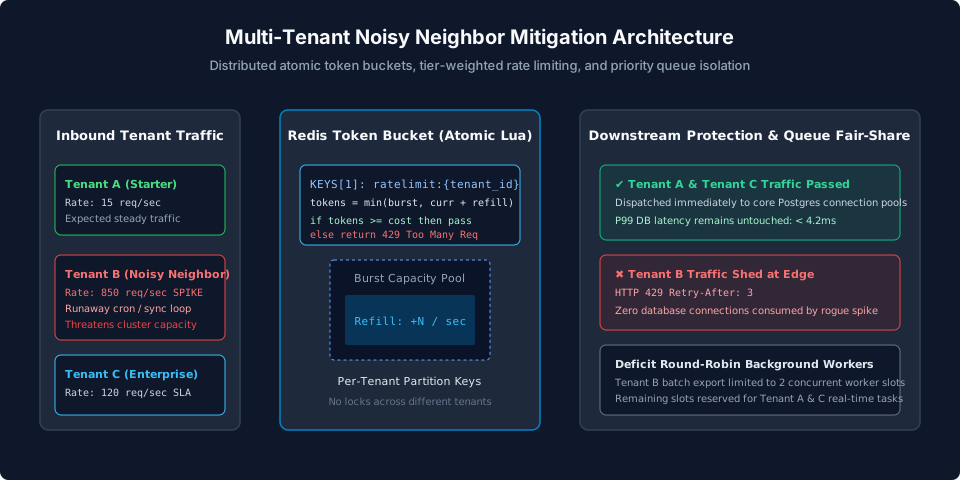
In any multi-tenant cloud systems architecture where infrastructure is shared, the noisy neighbor problem is an ever-present reliability hazard. A single customer writing an un-paginated export script, running a runaway CI/CD loop, or launching a massive integration sync can suddenly flood your API with thousands of requests per second.
Without proactive traffic isolation, that rogue tenant will consume all available web server worker threads, exhaust PostgreSQL connection pools, and lock shared database CPU cores. Within seconds, response latencies for completely innocent customers spike from 50 milliseconds to timeouts, breaching service level agreements (SLAs) across your entire user base.
Mitigating noisy neighbors requires moving beyond generic global rate limiters. You must build an authenticated, tenant-aware rate limiting and load-shedding architecture. This guide covers the algorithms, Redis Lua implementation, tiered quota policies, and queue isolation techniques needed to protect your shared cloud infrastructure from rogue traffic spikes.
Why Standard IP Rate Limiting Fails in enterprise cloud platform
Many off-the-shelf API gateways provide rate limiting based on client IP address. While IP-based throttling works well for consumer websites to prevent brute-force login attempts, it actively causes harm in Enterprise applications:
- Corporate NAT Collisions: An enterprise customer with 5,000 employees often accesses your cloud platform through a single outbound corporate firewall or proxy IP. Throttling by IP will lock out thousands of legitimate knowledge workers because of one employee's automated script.
- Distributed Cloud Attacks: A rogue customer running a scraper across 100 AWS Lambda instances will present 100 rotating IP addresses, completely bypassing IP rate limits while hammering your backend.
- Lack of Commercial Context: IP limiters cannot distinguish between a free trial account and a Fortune 500 customer paying $150,000 annually who has purchased a high-throughput enterprise tier.
In cloud platform, rate limits must always be evaluated against the verified tenant identifier (tenant_id) extracted from an authenticated API key, session token, or validated hostname.
Algorithm Selection: Why Token Bucket Wins
There are four primary rate limiting algorithms used in production:
| Algorithm | Mechanism | Burst Handling | Memory Overhead | Verdict for multi-tenant cloud systems |
|---|---|---|---|---|
| Fixed Window Counter | Counts requests in fixed time slices (e.g. 60s) | Severe edge burst (2x quota at boundary) | Very Low (1 counter) | Unsafe: Allows double bursts at window edges |
| Sliding Window Log | Stores exact timestamp of every request in Redis Sorted Set | Perfectly smooth | Extremely High (scales with request count) | Unviable: High memory cost for millions of calls |
| Sliding Window Counter | Weighted average of previous and current window | Good smoothing | Low (2 counters per tenant) | Good for gross volume limits |
| Token Bucket | Constant refill rate with a maximum burst capacity | Excellent: Accommodates legitimate UI bursts | Low (2 variables: tokens, last_refill) | Recommended: Best balance of burst tolerance and safety |
The Token Bucket algorithm is ideal for enterprise cloud platform because real software workflows are naturally bursty: a user refreshing a dashboard legitimately fires 15 API requests simultaneously, followed by 30 seconds of reading. The token bucket absorbs this initial burst without friction, while strictly enforcing the sustained average rate to protect the database.
Atomic Redis Lua Implementation
To prevent race conditions across distributed web servers, the token calculation must execute atomically on your Redis instance. If you execute a GET, compute the tokens in application memory, and execute a SET, concurrent requests will read stale token values and exceed the quota.
Here is an atomic Redis Lua script implementing the Token Bucket algorithm:
-- KEYS[1]: ratelimit:{tenant_id}:{tier}
-- ARGV[1]: max_capacity (burst limit)
-- ARGV[2]: refill_rate (tokens added per second)
-- ARGV[3]: request_cost (usually 1, higher for expensive queries)
-- ARGV[4]: current_timestamp (epoch seconds with microsecond precision)

local key = KEYS[1]
local max_capacity = tonumber(ARGV[1])
local refill_rate = tonumber(ARGV[2])
local cost = tonumber(ARGV[3])
local now = tonumber(ARGV[4])

-- Retrieve current bucket state
local data = redis.call("HMGET", key, "tokens", "last_updated")
local tokens = tonumber(data[1])
local last_updated = tonumber(data[2])

if tokens == nil then
    -- Cold bucket initialization: start with full burst capacity
    tokens = max_capacity
    last_updated = now
else
    -- Calculate tokens accrued since last request
    local elapsed = math.max(0, now - last_updated)
    tokens = math.min(max_capacity, tokens + (elapsed * refill_rate))
    last_updated = now
end

-- Determine if request has sufficient tokens
local allowed = 0
local remaining = tokens
local retry_after = 0

if tokens >= cost then
    allowed = 1
    tokens = tokens - cost
    remaining = tokens
else
    allowed = 0
    -- Time until enough tokens accumulate to satisfy cost
    local needed = cost - tokens
    retry_after = math.ceil(needed / refill_rate)
end

-- Save state back to Redis with a 1-hour idle expiration
redis.call("HMSET", key, "tokens", tokens, "last_updated", last_updated)
redis.call("EXPIRE", key, 3600)

return { allowed, math.floor(remaining), retry_after }
Integrating Rate Limiting into HTTP Middleware
In backend middleware, your request interceptor passes the authenticated tenant_id and the endpoint's weight to Redis before allowing the request to proceed to application handlers:
package middleware

import (
	"context"
	"fmt"
	"net/http"
	"strconv"
	"time"

	"github.com/redis/go-redis/v9"
)

type RateLimiter struct {
	rdb        *redis.Client
	scriptSHA  string
}

func (rl *RateLimiter) Middleware(cost int) func(http.Handler) http.Handler {
	return func(next http.Handler) http.Handler {
		return http.HandlerFunc(func(w http.ResponseWriter, r *http.Request) {
			tenant := GetTenant(r.Context())
			if tenant == nil {
				next.ServeHTTP(w, r)
				return
			}

			// Configure quotas by subscription tier
			burst, refill := getTierQuotas(tenant.Tier)
			key := fmt.Sprintf("ratelimit:%s:%s", tenant.ID, r.URL.Path)
			now := float64(time.Now().UnixNano()) / 1e9

			// Execute pre-loaded Lua script via EvalSha
			res, err := rl.rdb.EvalSha(r.Context(), rl.scriptSHA, []string{key}, burst, refill, cost, now).Slice()
			if err != nil {
				// Fail-open circuit breaker: log error and allow traffic if Redis blips
				fmt.Printf("Rate limit Redis error: %v; failing open\n", err)
				next.ServeHTTP(w, r)
				return
			}

			allowed := res[0].(int64) == 1
			remaining := res[1].(int64)
			retryAfter := res[2].(int64)

			// Set standard IETF rate limit headers
			w.Header().Set("RateLimit-Limit", strconv.Itoa(burst))
			w.Header().Set("RateLimit-Remaining", strconv.FormatInt(remaining, 10))

			if !allowed {
				w.Header().Set("Retry-After", strconv.FormatInt(retryAfter, 10))
				w.Header().Set("Content-Type", "application/json")
				w.WriteHeader(http.StatusTooManyRequests)
				fmt.Fprintf(w, `{"error":"rate_limit_exceeded","retry_after":%d}`, retryAfter)
				return
			}

			next.ServeHTTP(w, r)
		})
	}
}

func getTierQuotas(tier string) (burst int, refillPerSec float64) {
	switch tier {
	case "enterprise":
		return 500, 100.0 // 500 burst, 100 req/sec sustained
	case "pro":
		return 100, 20.0  // 100 burst, 20 req/sec sustained
	default:
		return 25, 5.0    // 25 burst, 5 req/sec sustained (Starter)
	}
}
Advanced Defense: Cost-Weighted Endpoints and Priority Queues
Not all HTTP requests place equal strain on your backend. A simple GET /api/v1/users/me consumes 0.5ms of database CPU. In contrast, POST /api/v1/reports/export-csv scans millions of rows and consumes 100MB of RAM.
To protect against asymmetric denial-of-service:
- Assign Weighted Token Costs: Deduct 1 token for simple key-value reads, 5 tokens for complex filtered searches, and 20 tokens for heavy mutations or batch exports.
- Deficit Round-Robin Background Queues: Asynchronous workers should not pull from a single global FIFO queue. Assign each tenant their own queue partition, processing tasks in fair round-robin order so that one tenant's 50,000 bulk tasks cannot starve another tenant's real-time notifications.
Summary Checklist for Production
- Strip External Headers: Strip any client-submitted
X-Tenant-*orRateLimit-*headers at the reverse proxy. - Implement Circuit Breakers: If Redis is down, fail-open with an active PagerDuty alert rather than crashing all customer requests.
- Monitor 429 Ratios: Set alerts for any tenant triggering more than 100 HTTP 429 errors per minute—this signals a runaway customer integration or an upgrade sales opportunity.
- Return Clear Explanations: Include a human-readable error payload and precise
Retry-Afterheader so automated API clients can back off smoothly.
Frequently Asked Questions
Why is IP-based rate limiting ineffective for enterprise cloud platform?
In enterprise cloud platform, an entire enterprise customer (with hundreds of legitimate employees) often accesses your API through a single corporate NAT IP or VPN gateway. Rate limiting by IP will throttle innocent coworkers instead of the runaway script.
What happens if Redis becomes temporarily unavailable during rate limit evaluation?
Implement a fail-open circuit breaker in your application middleware. If Redis times out after 10 milliseconds, log an alert and allow the request through rather than taking down your entire API for all customers.
How does tiered rate limiting prevent revenue churn?
Tiered limits ensure that enterprise accounts paying higher contract values receive guaranteed burst capacity and dedicated quotas, while free or starter accounts cannot monopolize infrastructure.
How should rate limits handle background batch jobs versus interactive user clicks?
Separate background asynchronous tasks into isolated worker queues using Deficit Round-Robin scheduling, ensuring that bulk data imports never consume worker threads allocated to real-time UI requests.
What is the computational cost of evaluating a Redis rate limit on every API request?
When Redis is deployed in the same cloud availability zone as your application servers, an atomic Lua token bucket evaluation typically takes between 0.3 and 0.8 milliseconds, representing less than 1% of total request latency.
What is the standard HTTP header for informing clients of their remaining quota?
Use the IETF draft standard headers: RateLimit-Limit, RateLimit-Remaining, and RateLimit-Reset, accompanied by Retry-After when returning HTTP 429.