Implementing Enterprise SSO with SAML and OIDC in Modern Cloud Architecture
A deep architectural guide to building multi-tenant SAML 2.0 and OpenID Connect (OIDC) Single Sign-On, assertion validation, and JIT user provisioning.
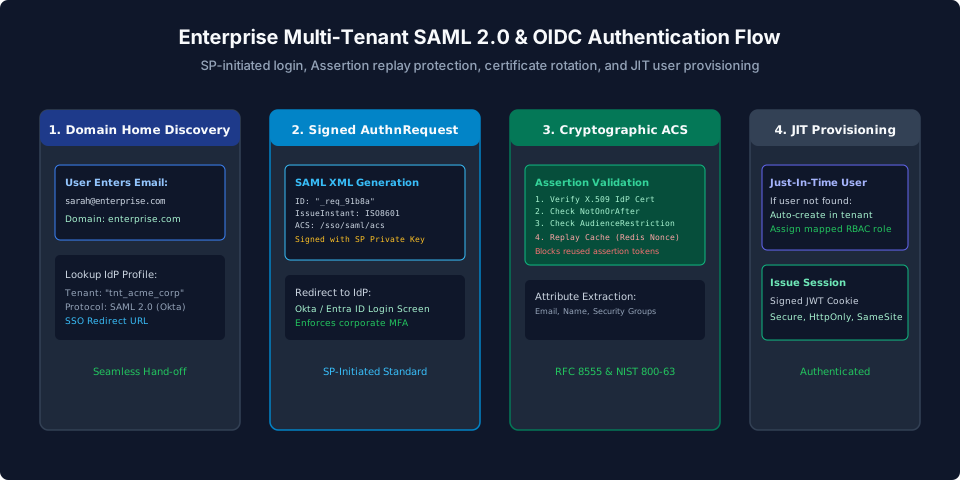
When your cloud software startup begins selling to mid-market and enterprise companies, you will encounter the "SSO Wall". Enterprise Chief Information Security Officers (CISOs) and IT administrators will refuse to approve your software unless it integrates with their centralized Identity Provider (IdP)—such as Okta, Microsoft Entra ID (formerly Azure AD), Ping Identity, or Google Workspace.
Enterprise IT teams demand Single Sign-On (SSO) because it enforces corporate Multi-Factor Authentication (MFA), prevents password reuse across employees, and—most importantly—ensures that when an employee is terminated, revoking their corporate identity immediately cuts off their access to all third-party cloud platform tools.
Supporting enterprise identity requires mastering two primary federation protocols: SAML 2.0 (the battle-tested XML standard dominant in enterprise) and OpenID Connect (OIDC) (the modern JSON/REST standard). This guide covers the end-to-end architecture for building multi-tenant SAML and OIDC authentication, defending against XML Signature Wrapping attacks, handling zero-downtime certificate rotation, and implementing Just-In-Time (JIT) user provisioning.
Protocol Comparison: SAML 2.0 vs. OpenID Connect
| Architectural Aspect | SAML 2.0 (Security Assertion Markup Language) | OIDC (OpenID Connect 1.0) |
|---|---|---|
| Data Format | XML with XML-DSig cryptographic signatures | JSON Web Tokens (JWT) with JSON Web Signatures (JWS) |
| Transport | Base64-encoded HTTP POST or HTTP Redirect | Standard REST API / OAuth 2.0 Authorization Code flow |
| Enterprise Adoption | Ubiquitous legacy and modern enterprise standard | High adoption in cloud-native and modern IT environments |
| Parser Attack Surface | High (vulnerable to XML Entity Expansion & Signature Wrapping) | Low (standard JSON and cryptographic signature verification) |
| Metadata Configuration | Static XML metadata document exchange | Dynamic JSON discovery endpoint (/.well-known/openid-configuration) |
While OIDC is vastly simpler and safer to parse, SAML 2.0 remains mandatory for enterprise enterprise cloud platform because thousands of established corporations exclusively configure their corporate directories via SAML.
The SP-Initiated SAML Authentication Lifecycle
The Service Provider-Initiated (SP-Initiated) flow is the recommended, secure login pattern:
[ User Browser ]      [ Your cloud application (SP) ]      [ Customer IdP (Okta/Entra) ]
       |                              |                                      |
       | 1. Enter email (acme.com)    |                                      |
       |----------------------------->|                                      |
       |                              | 2. Lookup IdP config for acme.com    |
       |                              |    Generate signed AuthnRequest      |
       | 3. HTTP 302 Redirect to IdP  |                                      |
       |<-----------------------------|                                      |
       |                                                                     |
       | 4. Follow Redirect to IdP Login Page                                |
       |-------------------------------------------------------------------->|
       |                                                                     | 5. Authenticate user
       |                                                                     |    (Password + MFA)
       | 6. Return HTML Form with signed SAMLAssertion                       |
       |<--------------------------------------------------------------------|
       |                                                                     |
       | 7. Auto-submit POST to Assertion Consumer Service (ACS)             |
       |----------------------------->|                                      |
       |                              | 8. Verify XML Signature & NotOnOrAfter
       |                              |    JIT Provision user if missing     |
       |                              |    Issue session cookie              |
       | 9. HTTP 302 to Dashboard     |                                      |
       |<-----------------------------|                                      |
Critical Security Vulnerabilities in SAML Implementations
Because SAML relies on complex XML structures, standard parsers are susceptible to subtle, high-severity vulnerabilities:
1. XML Signature Wrapping (XSW) Attacks
In an XSW attack, an attacker intercepts a legitimate SAML response from their IdP, copies the valid digital signature, and injects a cloned, modified <Assertion> element into a different section of the XML document. If your parser validates the signature on the original assertion but extracts the user identity from the cloned rogue assertion, an attacker can impersonate any corporate executive!
Architectural Defense:
- Use a battle-tested library (such as
crewjam/saml). - Verify that the digital signature explicitly references the exact element ID of the assertion you are deserializing.
- Reject any SAML response containing more than one
<Assertion>element.
2. Assertion Replay Attacks
A malicious actor who intercepts an employee's SAML response on an insecure network could theoretically re-submit that assertion to your ACS endpoint to establish an unauthorized session.
Architectural Defense:
Extract the unique ID attribute from the <saml:Assertion> (e.g. _98f12a...) and the NotOnOrAfter expiration timestamp:
func (s *SAMLHandler) CheckReplay(ctx context.Context, assertionID string, expiresAt time.Time) error {
	ttl := time.Until(expiresAt)
	if ttl <= 0 {
		return errors.New("assertion has already expired")
	}

	// Atomic check-and-set in Redis
	key := fmt.Sprintf("saml_nonce:%s", assertionID)
	set, err := s.rdb.SetNX(ctx, key, "1", ttl).Result()
	if err != nil {
		return fmt.Errorf("redis check failed: %w", err)
	}

	if !set {
		return errors.New("SAML assertion replay attack detected: nonce already consumed")
	}

	return nil
}
If the assertion ID has already been recorded in Redis, abort authentication immediately.
Zero-Downtime X.509 Certificate Rotation
Every SAML IdP signs assertions using an X.509 cryptographic certificate that typically expires every 1 to 3 years. When a customer's corporate IT team rotates this certificate, your cloud platform must continue accepting logins without breaking.
The Solution: In your tenant configuration database, store two certificate slots:
primary_certificate: The currently active public signing certificate.secondary_certificate: An optional next-scheduled certificate uploaded by the IT team before their cutover.
func VerifyAssertionSignature(assertionXML []byte, primaryCert, secondaryCert *x509.Certificate) error {
	// Try primary certificate first
	err := xmlsec.Verify(assertionXML, primaryCert)
	if err == nil {
		return nil
	}

	// Fallback to secondary certificate if configured during rotation window
	if secondaryCert != nil {
		if errSec := xmlsec.Verify(assertionXML, secondaryCert); errSec == nil {
			return nil
		}
	}

	return errors.New("invalid SAML signature: failed verification against both primary and secondary certificates")
}
Just-In-Time (JIT) User Provisioning
Enterprise IT teams do not want to manually invite hundreds of employees one by one. When an employee logs in via corporate SSO for the first time, your application should perform Just-In-Time (JIT) Provisioning:
func (s *SAMLHandler) JITProvisionUser(ctx context.Context, tenantID string, samlAttrs SAMLAttributes) (*User, error) {
	// 1. Check if user already exists by external Subject/NameID
	user, err := s.userRepo.FindByExternalID(ctx, tenantID, samlAttrs.NameID)
	if err == nil {
		// Update mutable fields (name, department) and return
		user.Name = samlAttrs.FirstName + " " + samlAttrs.LastName
		return s.userRepo.Update(ctx, user)
	}

	// 2. Auto-create new user account in tenant workspace
	newUser := &User{
		ID:         uuid.NewString(),
		TenantID:   tenantID,
		ExternalID: samlAttrs.NameID,
		Email:      samlAttrs.Email,
		Name:       samlAttrs.FirstName + " " + samlAttrs.LastName,
		Role:       mapRoleFromSAMLGroups(samlAttrs.SecurityGroups),
		CreatedAt:  time.Now(),
	}

	return s.userRepo.Create(ctx, newUser)
}
The user arrives directly at their personal workspace without registration forms, password creation, or email confirmation links.
Summary Checklist for Production
- Prioritize SP-Initiated SSO: Route logins through your domain discovery screen rather than unauthenticated IdP-initiated entry points.
- Enforce Replay Protection: Cache SAML Assertion IDs in Redis with TTL matching
NotOnOrAfter. - Dual-Certificate Support: Support primary and secondary certificate slots to prevent outages during annual certificate renewals.
- XSW Hardening: Ensure XML signature validators check element IDs explicitly and prohibit multiple assertion nodes.
- Automate JIT Provisioning: Map corporate directory security groups to internal application RBAC roles automatically.
Frequently Asked Questions
What is the difference between SP-Initiated and IdP-Initiated SSO?
In SP-Initiated SSO, the user begins at your app (e.g. typing their email on your login page) and is redirected to their corporate IdP. In IdP-Initiated SSO, the user clicks your app tile inside their corporate Okta dashboard, sending an unsolicited SAML assertion directly to your ACS endpoint.
Why is IdP-Initiated SSO considered a security risk?
IdP-Initiated SSO lacks an in-flight request state (InResponseTo) to bind the login to a specific browser session, making it vulnerable to Login Cross-Site Request Forgery (CSRF). SP-Initiated SSO is strictly recommended by NIST guidelines.
How do you handle IdP X.509 certificate rotation without downtime?
Store both the current active signing certificate and a next-scheduled certificate in your tenant configuration. When validating assertions, accept signatures from either valid certificate during the customer's rotation window.
What happens if a user's email address changes in their corporate identity provider?
Never bind user accounts solely to the mutable email string. Use the immutable NameID or OIDC sub (Subject) claim as the persistent foreign key matching your local user database.
How do you enforce single sign-on exclusively while allowing emergency fallback?
Allow workspace owners to toggle an 'Enforce SSO' setting that disables password logins for their domain, but maintain a protected break-glass recovery mechanism with hardware security keys for super-admins.
What is SCIM and how does it relate to SSO?
SSO handles authentication (who the user is when they log in). SCIM (System for Cross-domain Identity Management) is a complementary REST protocol that handles automated provisioning and instant de-provisioning when an employee is terminated in HR software.