Designing Scalable RBAC and ABAC Authorization Models in Enterprise Applications
Architect fine-grained authorization in cloud platform by evolving from simple role-based access control (RBAC) to dynamic attribute-based access control (ABAC).
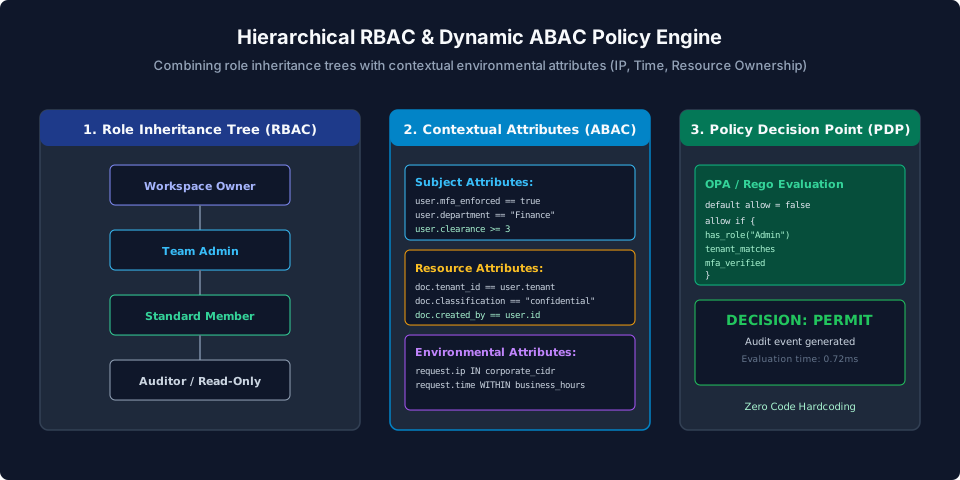
Every cloud application begins its authorization lifecycle with a simple enum: Role: Admin | Member | Viewer. In the early days of your product, this simple Role-Based Access Control (RBAC) model is completely adequate: admins can invite users and update billing; members can create resources; viewers can only read.
As your product expands into mid-market and enterprise accounts, this simple hierarchy collapses under customer pressure:
- "Our medical compliance officer needs to view patient audit logs, but cannot view billing invoices."
- "Regional sales managers should only edit accounts located in their geographic territory."
- "Contractors should only access files between 09:00 and 17:00 when connecting from corporate VPN IP addresses."
If you try to solve these requirements with pure RBAC, you experience Role Explosion: your database fills with dozens of hyper-specific roles (Billing_Admin_NorthAmerica, Medical_Viewer_Contractor). IT administrators struggle to manage permissions, and developers must constantly refactor code to handle new role permutations.
The solution is evolving from coarse-grained RBAC to a hybrid RBAC-ABAC architecture using Attribute-Based Access Control (ABAC). This guide provides the complete architectural framework for building scalable authorization using relational role models and Open Policy Agent (OPA).
The Authorization Spectrum: RBAC, ReBAC, and ABAC
Understanding the boundaries of each authorization pattern is critical before writing code:
| Model | Mechanism | Best Use Case | Operational Limitation |
|---|---|---|---|
| RBAC (Role-Based) | Permissions mapped to static roles (user -> role -> permissions) |
Coarse organization roles (Owner, Member, Billing) | Fails on contextual constraints (time, location, ownership) |
| ReBAC (Relationship-Based) | Access derived from graph edges (e.g. Google Zanzibar / "user is editor of folder containing doc") | Document hierarchies, collaboration trees, nested teams | Complex graph traversals; higher query latency |
| ABAC (Attribute-Based) | Access evaluated dynamically against boolean expressions over Subject, Resource, and Environment | Complex enterprise governance, compliance constraints | Requires clean attribute pipelines and policy evaluation engine |
The Hybrid Pragmatic Pattern
The most robust modern cloud platform authorization model combines RBAC and ABAC:
- Use Hierarchical RBAC for standard user assignment (e.g. assigning Jane the "Editor" role).
- Use ABAC Policies to enforce dynamic contextual guardrails (e.g. "Editors can only modify documents if
document.department == user.departmentandrequest.mfa == true").
Relational Schema for Custom Tenant Roles
Enterprise customers frequently demand the ability to define their own custom roles. To support this without altering your database schema, design a normalized relational permission table:
-- Core atomic permissions
CREATE TABLE permissions (
    id TEXT PRIMARY KEY, -- e.g. 'documents:create', 'billing:view', 'audit:export'
    category TEXT NOT NULL,
    description TEXT NOT NULL
);

-- Tenant-scoped custom roles
CREATE TABLE roles (
    id UUID PRIMARY KEY DEFAULT gen_random_uuid(),
    tenant_id UUID NOT NULL REFERENCES tenants(id),
    name TEXT NOT NULL,
    is_system BOOLEAN NOT NULL DEFAULT false, -- true for built-in Admin/Viewer
    created_at TIMESTAMPTZ NOT NULL DEFAULT NOW(),
    UNIQUE(tenant_id, name)
);

-- Join table mapping roles to permissions
CREATE TABLE role_permissions (
    role_id UUID NOT NULL REFERENCES roles(id) ON DELETE CASCADE,
    permission_id TEXT NOT NULL REFERENCES permissions(id),
    PRIMARY KEY(role_id, permission_id)
);

-- User role assignments
CREATE TABLE user_roles (
    user_id UUID NOT NULL REFERENCES users(id) ON DELETE CASCADE,
    role_id UUID NOT NULL REFERENCES roles(id) ON DELETE CASCADE,
    tenant_id UUID NOT NULL REFERENCES tenants(id),
    PRIMARY KEY(user_id, role_id)
);
By scoping roles to tenant_id, customer administrators can build custom roles through your UI, checking off permissions from your central catalog without requiring software deployments.
Declarative ABAC with Open Policy Agent (OPA)
Hardcoding complex attribute logic into application handlers (if user.Dept == doc.Dept && time.Now().Hour() > 9 ...) scatters security rules across your codebase, making compliance audits nearly impossible.
Instead, decouple policy evaluation using Open Policy Agent (OPA) and write declarative policies in Rego:
package cloud platform.authz

default allow = false

# 1. Multi-Tenant Isolation Guardrail (MANDATORY)
# Deny access immediately if tenant boundaries do not match
tenant_boundary_valid {
    input.subject.tenant_id == input.resource.tenant_id
}

# 2. Workspace Owners have full access
allow {
    tenant_boundary_valid
    "workspace_owner" in input.subject.roles
}

# 3. Dynamic Document Modification Policy (ABAC)
allow {
    tenant_boundary_valid
    "document_editor" in input.subject.roles
    input.action == "documents:update"

    # Contextual Attribute: User must belong to the document's department
    input.subject.department == input.resource.department

    # Security Attribute: User session must have verified MFA
    input.subject.mfa_authenticated == true

    # Environmental Attribute: Must originate from corporate IP range
    net.cidr_contains(input.env.corporate_cidr, input.env.client_ip)
}
Embedding OPA Directly for Sub-Millisecond Decisions
While OPA can run as a standalone sidecar daemon, calling it over HTTP adds network latency (2ms to 5ms). You can embed the OPA engine directly as an in-process library, executing Rego policies in under 200 microseconds:
package authz

import (
	"context"
	"fmt"
	"github.com/open-policy-agent/opa/rego"
)

type Authorizer struct {
	query rego.PreparedEvalQuery
}

func NewAuthorizer(ctx context.Context, regoPolicy string) (*Authorizer, error) {
	r := rego.New(
		rego.Query("data.cloud platform.authz.allow"),
		rego.Module("authz.rego", regoPolicy),
	)

	// Pre-compile query for extreme performance
	prepared, err := r.PrepareForEval(ctx)
	if err != nil {
		return nil, fmt.Errorf("preparing rego query: %w", err)
	}

	return &Authorizer{query: prepared}, nil
}

type AuthzInput struct {
	Subject  SubjectContext  `json:"subject"`
	Resource ResourceContext `json:"resource"`
	Action   string          `json:"action"`
	Env      EnvContext      `json:"env"`
}

func (a *Authorizer) Can(ctx context.Context, input AuthzInput) (bool, error) {
	results, err := a.query.Eval(ctx, rego.EvalInput(input))
	if err != nil {
		return false, err
	}

	if len(results) > 0 && len(results[0].Expressions) > 0 {
		if allowed, ok := results[0].Expressions[0].Value.(bool); ok {
			return allowed, nil
		}
	}

	return false, nil
}
Caching Attribute Context & Batch Policy Evaluation
In complex user interfaces—such as an enterprise administration table displaying 100 documents—evaluating permissions sequentially (100 distinct Can() calls) introduces UI latency.
To achieve high throughput:
- Pre-Fetch Subject Attributes Once: When an HTTP request begins, resolve the user's roles, team memberships, and security clearance in a single database or Redis lookup and bind them to the request context.
- Batch Query Evaluation in Rego: Instead of evaluating one document at a time, pass an array of document IDs to a vectorized Rego rule that returns the set of allowed IDs in a single pass:
# Vectorized Batch Evaluation in OPA
allowed_document_ids contains doc.id if {
    some doc in input.documents
    doc.tenant_id == input.subject.tenant_id
    doc.department == input.subject.department
}
This reduces 100 individual policy evaluations into a single in-memory evaluation taking less than 0.6 milliseconds.
Machine-to-Machine (M2M) API Authorization
In modern cloud platform, human users are only half the authorization equation. Enterprise customers frequently connect external scripts, GitHub Actions, and Zapier integrations using API Keys and OAuth 2.0 Client Credentials.
How should M2M tokens be integrated into your RBAC/ABAC model?
- Avoid Creating Ghost Users: Never create a fake "user" account for automated API keys.
- Service Principals with Scoped Permissions: Treat API keys as dedicated
Service Principalsassigned to specific roles with narrow permission scopes (e.g.read:invoices,write:webhooks). - IP Allowlisting via Environmental ABAC: Enterprise customers should be able to restrict an API key so that it can only be used from designated static corporate IP CIDR ranges, enforced transparently by your OPA policy.
| Authorization Vector | Human Interactive Session | Machine-to-Machine (API Key) |
|---|---|---|
| Identity Source | SAML 2.0 / OIDC IdP Session | SHA-256 Hashed API Secret Token |
| Credential Storage | Secure HttpOnly Session Cookie | Authorization: Bearer sec_... |
| Permission Scope | Broad Role (Owner, Editor, Member) | Narrow Least-Privilege Scopes |
| Environmental Rules | Browser fingerprint, MFA status | Static CIDR IP Whitelist, Rate Limit Tier |
Automated Unit Testing for Rego Policies
Just as you write unit tests for your backend business logic, you must write automated unit tests for your authorization rules. Rego includes a native testing runner (opa test):
package cloud platform.authz_test

import data.cloud platform.authz

# Test: Cross-tenant access must ALWAYS be denied
test_cross_tenant_denied if {
    not authz.allow with input as {
        "subject": {"tenant_id": "tenant_a", "roles": ["workspace_owner"]},
        "resource": {"tenant_id": "tenant_b", "department": "Finance"},
        "action": "documents:update"
    }
}

# Test: Editor in same department permitted
test_same_dept_editor_allowed if {
    authz.allow with input as {
        "subject": {
            "tenant_id": "tenant_a",
            "roles": ["document_editor"],
            "department": "Engineering",
            "mfa_authenticated": true
        },
        "resource": {"tenant_id": "tenant_a", "department": "Engineering"},
        "action": "documents:update",
        "env": {"client_ip": "10.0.1.5", "corporate_cidr": "10.0.0.0/16"}
    }
}
Run these tests in your CI pipeline before building your application binary. If a junior developer modifies a policy and accidentally opens an unintended permission loophole, the build breaks immediately.
Summary Checklist for Production
- Establish Multi-Tenant Guardrails: Every authorization check must verify
subject.tenant_id == resource.tenant_idbefore evaluating roles. - Decouple Policy from Handlers: Use declarative policy languages (Rego/OPA) rather than nested
if/elsestatements. - Embed In-Process: Compile policy queries at server startup to achieve sub-millisecond evaluation times.
- Support Batch Vectorized Checks: Allow bulk UI lists to evaluate permissions in a single OPA pass.
- Isolate M2M Service Principals: Manage API keys as distinct entities with IP CIDR constraints.
- Write Automated Policy Tests: Treat security policies like code: write unit tests covering positive and negative edge cases.
- Log Evaluation Context: Record the exact Subject, Resource, and Decision in your audit log for SOC 2 compliance verification.
Frequently Asked Questions
What is 'Role Explosion' and why does it break standard RBAC?
Role explosion occurs when an application creates dozens of bespoke roles (e.g. 'Billing_Viewer_US', 'Billing_Editor_EU') to satisfy granular customer permissions. Within a year, administrators cannot manage hundreds of overlapping roles.
How do you avoid latency when evaluating complex ABAC policies?
Pass pre-fetched user and resource attributes directly in the evaluation request context to an in-process policy engine (such as embedded OPA) to avoid downstream database queries during policy evaluation.
How should custom customer-defined roles be stored in the database?
Create a normalized relational schema with `roles`, `permissions`, and `role_permissions` join tables scoped to `tenant_id`, allowing enterprise admins to construct custom roles dynamically.
What is the difference between PEP and PDP in authorization architecture?
The Policy Enforcement Point (PEP) is your HTTP middleware or API handler that intercepts requests. The Policy Decision Point (PDP) is the engine (e.g. OPA) that receives the context, evaluates policies, and returns a binary PERMIT or DENY.
Can ABAC handle multi-tenant isolation rules?
Yes. A foundational ABAC policy rule states: `resource.tenant_id == subject.tenant_id`. If this rule fails, access is denied immediately before any other role permissions are checked.
How do you test authorization policies before deploying them to production?
Rego policies support automated unit testing (`opa test`). You write unit tests asserting that unauthorized attribute combinations evaluate to false before committing policy files.