Engineering Immutable Audit Logs for SOC 2 and HIPAA Compliance
A technical guide to architecting append-only, tamper-evident audit logs with cryptographic hash-chaining and S3 Object Lock for enterprise compliance.
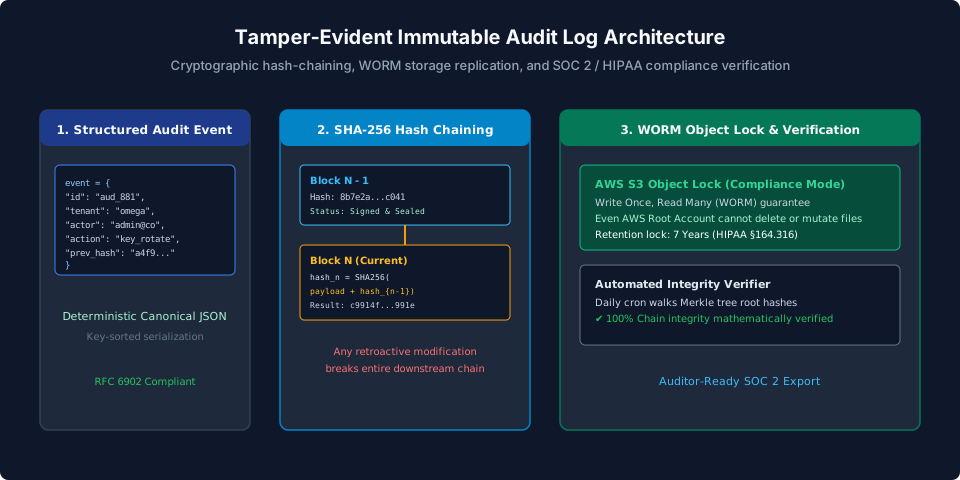
When preparing your cloud software platform for an enterprise security audit—whether achieving SOC 2 Type II certification or proving HIPAA § 164.312(b) compliance—the first artifact auditors request is your Audit Log System. Auditors want to verify that every time a user logs in, exports customer data, changes permissions, or invites a team member, a permanent, tamper-evident record is created.
Many startups mistakenly satisfy this requirement by creating a simple SQL table: INSERT INTO audit_logs (action, user_id) VALUES (...).
To an experienced security auditor, this simple approach fails immediately. Why? In a standard relational database, any database administrator with UPDATE or DELETE privileges can silently modify historical records, erase traces of an insider data theft, or falsify timestamps.
To satisfy rigorous compliance standards, your audit log architecture must be verifiably immutable and tamper-evident. This guide details how to construct an append-only audit logging pipeline using deterministic JSON canonicalization (RFC 8785), SHA-256 cryptographic hash-chaining, and Write Once, Read Many (WORM) storage.
What Must Be Logged: The Five W's of Compliance
Every compliant audit event must answer five core questions with zero ambiguity:
- Who (Subject): The actor's user UUID, email, IP address, user agent, and authentication method (e.g.
sso_samlvsapi_key). - What (Action): A structured, hierarchical verb (e.g.
user.invited,document.exported,billing.plan_updated). - Where (Target Resource): The affected entity type and UUID (e.g.
document:88192). - Whose (Tenant Scope): The tenant identifier (
tenant_id) ensuring strict customer data boundary enforcement. - When (Timestamp): An immutable UTC timestamp with millisecond precision (
2026-09-24T03:15:00.182Z).
{
  "id": "aud_01j8k9m2e3r4t5y6u7i8o9p0",
  "version": 1,
  "tenant_id": "c1209b55-89c0-42ab-8c9a-8b8201a4f001",
  "actor": {
    "id": "usr_99182",
    "email": "sarah.admin@enterprise.com",
    "ip": "198.51.100.42",
    "user_agent": "Mozilla/5.0 ...",
    "auth_method": "saml_sso"
  },
  "action": "role.permissions_updated",
  "resource": {
    "type": "role",
    "id": "role_editor_midwest",
    "name": "Midwest Editor"
  },
  "metadata": {
    "added_permissions": ["documents:export"],
    "removed_permissions": []
  },
  "timestamp": "2026-09-24T03:15:00.182Z",
  "previous_hash": "e3b0c44298fc1c149afbf4c8996fb92427ae41e4649b934ca495991b7852b855",
  "hash": "7a35b1c948e658e3f94689b78e932b1a9c34e8f192b781a938c471e9821a7192"
}
Making Logs Tamper-Evident: SHA-256 Hash Chaining
To guarantee that no bad actor can alter an audit record retroactively, use cryptographic hash-chaining (the fundamental data structure underlying blockchains and Git commits).
Each audit entry includes:
previous_hash: The SHA-256 digest of the immediately preceding audit record.hash: The SHA-256 digest of its own canonical payload concatenated withprevious_hash.
$$H_n = \text{SHA256}(\text{CanonicalJSON}(\text{Payload}n) + H{n-1})$$
If an attacker with database superuser access modifies even a single character in record $N-1$, its recomputed hash will change. Consequently, record $N$, $N+1$, and all subsequent records down the chain will fail cryptographic verification, exposing the tampering immediately.
Deterministic Hashing with RFC 8785 (JCS)
Standard JSON serializers output keys in arbitrary orders: { "a": 1, "b": 2 } versus { "b": 2, "a": 1 }. While semantically identical in JSON, their SHA-256 hashes are completely different.
To achieve consistent hashes across programming languages, serialize your JSON using the JSON Canonicalization Scheme (RFC 8785), which sorts keys lexicographically and strips extraneous whitespace:
package audit

import (
	"crypto/sha256"
	"encoding/hex"
	"fmt"
	"github.com/gowebpki/jcs"
)

func ComputeEventHash(payloadBytes []byte, previousHash string) (string, error) {
	// 1. Canonicalize JSON payload according to RFC 8785
	canonical, err := jcs.Transform(payloadBytes)
	if err != nil {
		return "", fmt.Errorf("canonicalizing JSON: %w", err)
	}

	// 2. Hash canonical JSON concatenated with previous block hash
	hasher := sha256.New()
	hasher.Write(canonical)
	hasher.Write([]byte(previousHash))

	return hex.EncodeToString(hasher.Sum(nil)), nil
}
Immutable WORM Storage with AWS S3 Object Lock
While hash-chaining makes tampering detectable, it does not prevent a malicious administrator from running DROP TABLE audit_logs; to destroy the entire history.
To achieve legal non-repudiation, stream your audit logs to Write Once, Read Many (WORM) storage using AWS S3 Object Lock configured in Compliance Mode:
[ Application Ingestion ]
           |
     (PostgreSQL)
           v
[ Periodic Batch Archiver ]
           |
     (Parquet / JSONL)
           v
[ AWS S3 Object Lock (Compliance Mode) ]
• WORM: Write Once, Read Many
• Retention: 7 Years (HIPAA Mandatory)
• Even AWS Root Account cannot delete or mutate files
Under Compliance Mode:
- No IAM user, role, or root credential can delete or overwrite objects during the retention window.
- The retention period cannot be shortened.
- This satisfies SEC Rule 17a-4(f), FINRA Rule 4511, and HIPAA § 164.316 storage requirements.
Streaming to Customer SIEMs: Splunk, Datadog, and OpenSearch
Enterprise procurement teams frequently require direct streaming of audit events into their Security Information and Event Management (SIEM) systems via webhooks or syslog forwarders:
- Splunk HTTP Event Collector (HEC): Stream canonical audit events directly to enterprise customer HEC endpoints using mutual TLS (mTLS) authentication and API bearer tokens.
- Buffer and Backpressure Management: Deliver audit events asynchronously through an intermediate buffer (such as AWS SQS, Apache Kafka, or Redis Streams). Avoid blocking user-facing HTTP transactions during SIEM outages.
- Exponential Backoff and Dead Letter Queues (DLQ): If a customer's SIEM endpoint returns HTTP 429 (Rate Limited) or HTTP 503 (Service Unavailable), retry with truncated exponential backoff up to 72 hours before routing failed events to an administrative DLQ.
- Per-Tenant Delivery Controls: Allow enterprise administrators to toggle event subscriptions (e.g. subscribing exclusively to
auth.failedandpermission.grantwhile suppressing high-frequency read audits).
Key Management and Signature Rotation (NIST SP 800-57)
Tamper-evident logs become even stronger when daily batch manifests are digitally signed using asymmetric private keys held in hardware security modules (AWS CloudHSM or Google Cloud KMS):
- Key Separation: Isolate the private signing key from application runtime environments. The audit verification worker requests signatures via strict IAM role assumptions.
- Key Rollover Schedules: Comply with NIST SP 800-57 recommendations by rotating asymmetric signing keys annually. Retain historical public keys in an append-only public certificate store to allow verification of historical archives spanning several years.
- Envelope Signatures: Include the
key_id, signature algorithm (Ed25519orRSA-PSS-SHA256), and timestamp within the daily signed compliance manifest alongside the root Merkle hash.
Automated Daily Integrity Verification
To satisfy SOC 2 auditors without manual panic, deploy an automated verification job that runs nightly:
func VerifyAuditChain(records []AuditRecord) (bool, error) {
	for i := 1; i < len(records); i++ {
		prev := records[i-1]
		curr := records[i]

		// 1. Verify chain continuity
		if curr.PreviousHash != prev.Hash {
			return false, fmt.Errorf("chain broken at index %d: expected previous_hash %s, got %s",
				i, prev.Hash, curr.PreviousHash)
		}

		// 2. Re-compute and verify hash
		recomputed, err := ComputeEventHash(curr.RawPayload, curr.PreviousHash)
		if err != nil || recomputed != curr.Hash {
			return false, fmt.Errorf("tamper detected at index %d: stored hash %s != recomputed %s",
				i, curr.Hash, recomputed)
		}
	}
	return true, nil
}
If the verification script passes, it cryptographically signs a daily compliance certificate. When your SOC 2 auditor reviews your controls, you present 365 signed certificates verifying unbroken chain integrity throughout the entire year.
Summary Checklist for Production
- Enforce the 5 W's: Ensure every audit payload includes Actor, Action, Resource, Tenant, and UTC Timestamp.
- Apply Deterministic Canonicalization: Use RFC 8785 JSON canonicalization before calculating SHA-256 hashes.
- Chain Records Cryptographically: Include
previous_hashin every audit record schema. - Stream to WORM S3 Storage: Configure S3 Object Lock in Compliance Mode with a 7-year retention policy.
- Automate Daily Verification: Schedule an automated verification job that walks the hash chain and confirms 100% integrity.
- Enable Outbound SIEM Streaming: Offer customer-managed Splunk HEC and Datadog webhook forwarders with DLQ resilience.
Frequently Asked Questions
What mandatory fields must an audit log event contain for SOC 2 and HIPAA?
Every audit event must record: who performed the action (actor_id, email, IP address), what action was taken (action enum), which resource was affected (resource_type, resource_id), which tenant workspace it belongs to (tenant_id), and the exact UTC timestamp.
What is the difference between Governance Mode and Compliance Mode in AWS S3 Object Lock?
In Governance Mode, users with specific IAM permissions can override the retention lock. In Compliance Mode, NO user (including the AWS root account) can delete, overwrite, or shorten the retention period until the lock expires, satisfying strict legal WORM requirements.
How long must cloud platform audit logs be retained for compliance?
SOC 2 Type II requires retaining logs for the entire active audit window (typically 12 months). HIPAA mandates retaining security and audit records for a minimum of 6 years from the date of creation.
Should audit logging run synchronously inside the user's HTTP request?
Audit events should be constructed in the handler and buffered to an asynchronous message queue (e.g. SQS or Kafka) via the Transactional Outbox pattern, preventing audit storage latency from slowing down user responses.
Can customer administrators view and export their own audit logs?
Yes. Enterprise customers expect an in-app Audit Log viewer and automated SIEM streaming (e.g. exporting to Splunk, Datadog, or S3) filtered strictly to their tenant_id.
How do you detect if someone tampered with an audit log database?
Run an automated verification worker that iterates through the hash chain sequentially: re-computing SHA256(payload + previous_hash) for every row. If any record's stored hash fails to match the recomputed value, an alert is triggered immediately.