Designing Resilient Background Job Queues for Multi-Tenant Workloads
Architect high-availability cloud platform background worker queues using Deficit Round-Robin scheduling to prevent large batch jobs from starving interactive tasks.
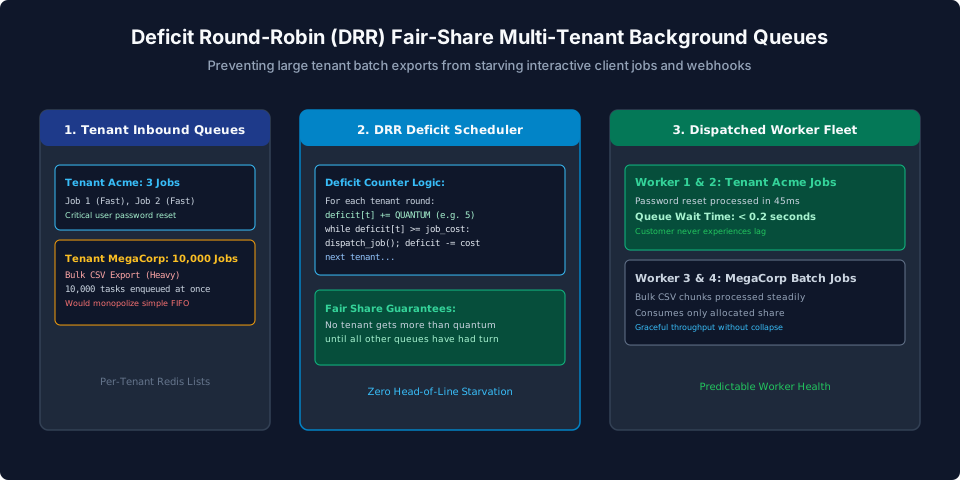
In almost every modern cloud software architecture, heavy or non-blocking tasks are offloaded to background job queues: sending transactional emails, processing bulk CSV imports, generating PDF invoices, syncing Salesforce webhooks, and recalculating analytics metrics.
In a single-tenant environment, a simple First-In, First-Out (FIFO) queue managed by Redis or RabbitMQ works reliably.
In a multi-tenant cloud systems application, however, a global FIFO queue is an operational landmine:
- An enterprise customer initiates a bulk migration, enqueuing 100,000 document processing tasks at 09:00.
- Meanwhile, an executive at a different company clicks "Forgot Password" or triggers an urgent customer webhook.
- Because all jobs share the same global queue, the critical password reset is queued behind 100,000 bulk tasks. The executive waits 45 minutes for a password reset email!
This failure mode is called Head-of-Line Starvation. A single high-volume tenant completely monopolizes your background worker fleet, degrading response times across your entire customer base.
To build a reliable multi-tenant background processing pipeline, you must implement Fair-Share Scheduling using algorithms like Deficit Round-Robin (DRR). This guide provides the complete blueprint for architecting resilient multi-tenant queues, incorporating queue tiers, poison-pill isolation, and automated Dead-Letter Queues (DLQs).
The Flaw of Global FIFO Queues in Multi-Tenancy
Consider what happens inside a naive worker pool pulling from a single Redis list:
[ Global Queue (FIFO) ]
[ Job 1 (Tenant B) ] -> [ Job 2 (Tenant B) ] -> ... -> [ Job 50,000 (Tenant B) ] -> [ Password Reset (Tenant A) ]
                                                                                             |
                                                                                    (Stuck waiting for hours!)
Even if you scale your worker pods from 5 to 50, all 50 workers will spend their cycles processing Tenant B's bulk backlog. Tenant A's interactive experience is destroyed.
Solution: The Deficit Round-Robin (DRR) Scheduler
Deficit Round-Robin (DRR) is an algorithm originally designed for network packet routing that guarantees fair-share execution among concurrent queues without requiring prior knowledge of task runtimes.
In a DRR multi-tenant queue:
- Each tenant has their own isolated queue list in Redis:
queue:tenant:{tenant_id}. - The scheduler maintains an active list of tenants who currently have pending jobs.
- Each tenant has a Deficit Counter, initialized to 0.
- In each round, the scheduler visits each active tenant and adds a fixed Quantum (e.g. 5 credits) to their deficit counter.
- While the tenant's deficit counter is greater than or equal to the job cost (typically 1 credit), the scheduler dispatches a job from that tenant's queue to an available worker thread and subtracts the cost.
- Once the deficit is exhausted or the queue is empty, the scheduler moves immediately to the next tenant.
Round 1:
- Tenant A (3 jobs pending):   Deficit += 5 -> Dispatches all 3 jobs -> Deficit = 2.
- Tenant B (50,000 pending):   Deficit += 5 -> Dispatches 5 jobs     -> Deficit = 0.
- Tenant C (1 job pending):    Deficit += 5 -> Dispatches 1 job      -> Deficit = 4.

Result: Tenant A and Tenant C have their jobs completed instantly!
Tenant B's massive backlog progresses steadily without starving anyone.
Implementation: Multi-Tenant Fair-Share Dispatcher
Here is a lightweight, high-performance DRR dispatcher:
package worker

import (
	"context"
	"fmt"
	"sync"
	"time"
	"github.com/redis/go-redis/v9"
)

type DRRScheduler struct {
	rdb          *redis.Client
	quantum      int
	deficits     map[string]int
	activeTenants []string
	mu           sync.Mutex
}

func NewDRRScheduler(rdb *redis.Client, quantum int) *DRRScheduler {
	return &DRRScheduler{
		rdb:      rdb,
		quantum:  quantum,
		deficits: make(map[string]int),
	}
}

func (s *DRRScheduler) DispatchNextJob(ctx context.Context) (*JobPayload, error) {
	s.mu.Lock()
	defer s.mu.Unlock()

	if len(s.activeTenants) == 0 {
		// Refresh active tenant queue set from Redis
		tenants, err := s.rdb.SMembers(ctx, "active_tenant_queues").Result()
		if err != nil || len(tenants) == 0 {
			return nil, nil // No jobs across any tenant
		}
		s.activeTenants = tenants
	}

	for len(s.activeTenants) > 0 {
		tenantID := s.activeTenants[0]
		// Add quantum credits to current tenant
		s.deficits[tenantID] += s.quantum

		queueKey := fmt.Sprintf("queue:tenant:%s", tenantID)

		// Dispatch jobs while deficit allows
		for s.deficits[tenantID] > 0 {
			// Pop single job from tenant's Redis list
			payloadJSON, err := s.rdb.RPop(ctx, queueKey).Result()
			if err == redis.Nil {
				// Tenant queue is empty; remove from active rotation
				s.rdb.SRem(ctx, "active_tenant_queues", tenantID)
				s.deficits[tenantID] = 0
				break
			} else if err != nil {
				return nil, err
			}

			// Job found! Decrement deficit and return for worker execution
			s.deficits[tenantID]--
			return DeserializeJob(payloadJSON)
		}

		// Move to next tenant in round-robin fashion
		s.activeTenants = append(s.activeTenants[1:], tenantID)
	}

	return nil, nil
}
Queue Categorization: Priority Classes
In addition to per-tenant fairness, categorize jobs into three distinct Priority Tiers:
| Queue Class | Typical Tasks | Latency SLA | Dedicated Worker Share |
|---|---|---|---|
| Priority: Interactive | Password resets, 2FA SMS codes, instant webhooks | < 2 seconds | 40% of worker pool (guaranteed reserved capacity) |
| Priority: Default | Standard notifications, background data syncs, PDF generation | < 60 seconds | 40% of worker pool |
| Priority: Bulk / Batch | CSV exports, historical backfills, automated database maintenance | < 4 hours | 20% of worker pool (strictly throttled) |
By reserving a dedicated slice of worker threads exclusively for the Interactive queue, critical customer authentication emails are processed immediately, even if all other queues are experiencing massive volume spikes.
Poison-Pill Isolation: Dead-Letter Queues (DLQ)
A poison-pill job is a corrupted payload or unhandled edge case (e.g. an invalid JSON string or dividing by zero) that causes the worker process to panic and crash.
If your queue simply retries failed jobs immediately without bounds:
- Worker 1 pulls the poison job, panics, and restarts.
- The job returns to the queue.
- Worker 2 pulls the same job, panics, and restarts.
- Within 30 seconds, your entire worker cluster enters a crash-loop failure state.
The Automated DLQ Protocol
- Exponential Backoff with Jitter: When a job fails, schedule its retry with an increasing backoff interval:
$$\text{Backoff} = 2^{\text{attempt}} \times 1\text{s} + \text{rand}(0, 500\text{ms})$$ - Maximum Attempt Cap: Allow a maximum of 5 retry attempts.
- Dead-Letter Transfer: If attempt count exceeds 5, push the job payload and error stack trace to
queue:dlq:failed_jobs. - Trigger Alert: Fire a PagerDuty alert containing the
tenant_idand error context so engineers can inspect the malformed payload without blocking the pipeline.
Restoring Multi-Tenant Security Context in Workers
When an HTTP request executes, security middleware injects the user and tenant into the request context. In asynchronous background queues, this HTTP context does not exist.
Every job payload must carry a serialized security envelope:
{
  "job_id": "job_01j8k9m...",
  "tenant_id": "c1209b55-89c0-42ab-8c9a-8b8201a4f001",
  "actor_user_id": "usr_99182",
  "task_type": "generate_monthly_report",
  "payload": { "month": 9, "year": 2026 }
}
When a worker pulls the job, it must restore the tenant context and database session variables before executing business logic:
func (w *Worker) ProcessJob(job *JobPayload) error {
	// Re-establish transaction-scoped RLS variable
	return WithTenantTx(context.Background(), w.db, job.TenantID, func(tx *sql.Tx) error {
		// Handler executes with full Row-Level Security isolation!
		return w.handlers[job.TaskType](tx, job.Payload)
	})
}
Summary Checklist for Production
- Eliminate Global FIFO Queues: Partition queues by
tenant_idto prevent single-tenant starvation. - Deploy Deficit Round-Robin (DRR): Ensure all concurrent active tenants receive a fair share of worker capacity.
- Separate Priority Classes: Dedicate at least 30% of worker threads exclusively to real-time interactive tasks.
- Enforce 5-Attempt Cap with DLQ: Route permanently failing jobs to a dead-letter queue with alerting.
- Restore RLS in Worker Threads: Set
app.current_tenant_idinside worker database transactions.
Frequently Asked Questions
What is Deficit Round-Robin (DRR) scheduling in background queues?
DRR is an algorithm that allocates worker capacity fairly by maintaining a deficit counter per tenant. In each round, each active tenant's counter increases by a fixed quantum; jobs are executed until the deficit is exhausted, preventing heavy tenants from monopolizing worker threads.
How do you prevent a poison-pill job from crashing your worker fleet in an infinite retry loop?
Cap retries at a fixed threshold (e.g. 5 attempts) using exponential backoff. If a job fails all attempts, move it to a Dead-Letter Queue (DLQ), log an error with the stack trace, and alert the on-call engineer.
Should database transactions wrap background job processing?
Wrap the job's internal state mutations within a database transaction, but never keep a database transaction open while making external network calls (such as sending an email or calling a third-party API) to avoid holding database locks.
How do you scale background workers dynamically during traffic spikes?
Scale worker pods based on queue latency (e.g. oldest job age > 15 seconds) rather than raw queue depth, because 10,000 bulk jobs with a 4-hour SLA should not trigger the same urgent autoscaling as 50 real-time jobs with a 5-second SLA.
How do you ensure jobs are idempotent if a worker restarts mid-execution?
Design jobs to check state before executing: store a unique job execution token in the database, verifying that the target record has not already been processed before applying mutations.
Can Redis handle thousands of separate per-tenant queue keys?
Yes. Redis lists are extremely lightweight. Maintaining 10,000 distinct `queue:{tenant_id}` keys consumes only a few megabytes of memory and allows flexible round-robin scheduling.