Calculating Tenant COGS: Attribution of Cloud Infrastructure Costs in Shared Architecture
A FinOps guide to attributing shared AWS/GCP Kubernetes compute, database clusters, and network egress down to individual platform tenant gross margins.
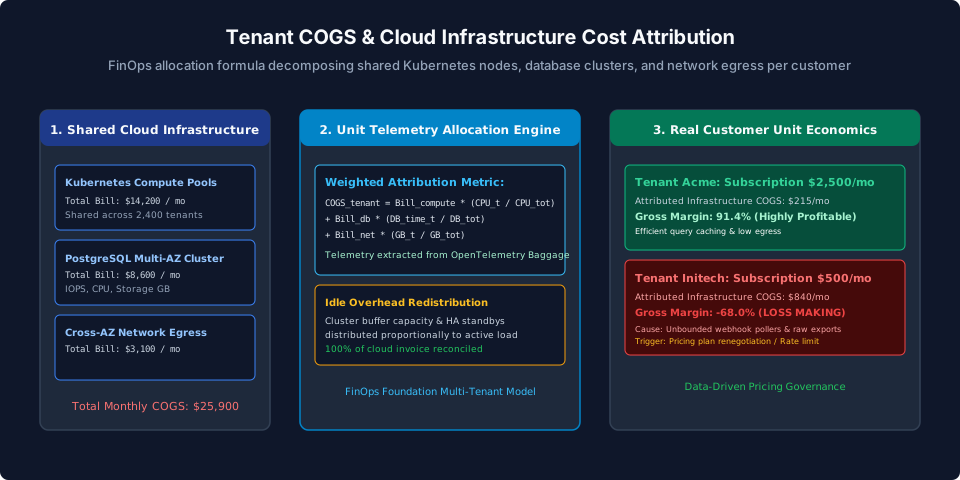
In the venture-backed cloud platform ecosystem, software businesses are prized for their high gross margins. Software does not require physical factories, warehouse inventory, or shipping fleets; an incremental customer costs pennies to serve. Public benchmarks demand that elite enterprise cloud platform companies maintain gross margins between 75% and 85%.
Yet behind aggregate financial reports, many cloud platform executives harbor a dangerous blind spot: they measure cloud costs only as a monolithic monthly bill (e.g. "Our AWS bill is $50,000 this month").
When engineering teams actually attribute that shared infrastructure down to individual customers, they discover alarming realities:
- A customer paying $500/month on a legacy flat-rate plan is consuming $2,400/month in OpenAI API tokens, multi-region database replication, and cross-AZ network egress.
- Your sales team celebrates signing a "marquee logo" for $50,000/year, unaware that the customer's intensive nightly data pipelines cost your company $70,000/year to host.
- One customer's negative 40% gross margin is quietly eroding the profits generated by 200 smaller, highly profitable accounts.
To protect enterprise profitability, you must build a Tenant COGS (Cost of Goods Sold) Attribution Pipeline. This guide presents the FinOps mathematical allocation formulas, telemetry instrumentation hooks, and cloud invoice decomposition techniques needed to measure per-tenant unit margins accurately.
What Belongs in cloud platform COGS?
Under US GAAP and international financial accounting standards, Cost of Goods Sold includes all direct expenses required to deliver and maintain the production software service:
+-------------------------------------------------------------------------+
| INCLUDED IN cloud platform COGS (Direct Operational Costs)                         |
| • Cloud Hosting Infrastructure (AWS EC2/EKS, RDS, S3, Edge CDN)        |
| • Third-Party Embedded APIs (Twilio SMS, OpenAI LLMs, SendGrid Email)   |
| • Payment Gateway Fees (Stripe interchange and merchant percentages)     |
| • Customer Support & Customer Success Engineer Salaries                  |
| • Site Reliability Engineering (SRE) & Production DevOps Salaries       |
+-------------------------------------------------------------------------+
| EXCLUDED FROM cloud platform COGS (Operating Expenses - OpEx)                     |
| • Feature Development Engineers & Product Managers (Booked as R&D)      |
| • Sales Commissions, Account Executives, & Marketing (Booked as S&M)     |
| • Executive Salaries, Office Leases, & Legal Counsel (Booked as G&A)     |
+-------------------------------------------------------------------------+
The Mathematical Attribution Model
When infrastructure is completely physically isolated (e.g. database-per-tenant on separate RDS instances), cost attribution is trivial: you sum the AWS resource cost tags matching that tenant ID.
In high-efficiency multi-tenant architectures where compute, databases, and network pipes are shared, you must allocate costs proportionally based on measured consumption telemetry weights:
$$\text{COGS}t = \left( C{\text{compute}} \times \frac{\text{CPU}t}{\text{CPU}{\text{tot}}} \right) + \left( C_{\text{db}} \times \frac{\text{DBTime}t}{\text{DBTime}{\text{tot}}} \right) + \left( C_{\text{storage}} \times \frac{\text{GB}t}{\text{GB}{\text{tot}}} \right) + \left( C_{\text{egress}} \times \frac{\text{BytesOut}t}{\text{BytesOut}{\text{tot}}} \right) + C_{\text{direct_apis}}$$
Where:
- $C_{\text{compute}}$: The monthly AWS EC2/EKS container bill.
- $\text{CPU}_t$: Total CPU core-seconds consumed by tenant $t$'s requests.
- $C_{\text{db}}$: The monthly Amazon RDS/Aurora PostgreSQL bill.
- $\text{DBTime}_t$: Total query execution time attributed to tenant $t$.
- $C_{\text{direct_apis}}$: Third-party API charges directly incurred by tenant $t$ (e.g. OpenAI token usage).
Distributing the Idle Buffer Capacity
No production cloud cluster runs at 100% capacity; clusters maintain a 30% to 50% idle buffer for high availability and failover.
FinOps best practice dictates that unallocated idle overhead must be redistributed proportionally across all tenants based on their active consumption share. This ensures that 100% of your cloud provider's invoice is reconciled down to the penny.
Telemetry Collection: Measuring Tenant Resource Consumption
How do you measure a tenant's fractional share of database CPU and container memory?
1. Database Query Execution Time
Configure your application connection pool to wrap database transactions with a lightweight OpenTelemetry span or session timer:
func QueryWithAttribution(ctx context.Context, db *sql.DB, tenantID string, query string, args ...any) (*sql.Rows, error) {
	start := time.Now()
	rows, err := db.QueryContext(ctx, query, args...)
	duration := time.Since(start)

	// Emit metric to Prometheus / OpenTelemetry Collector
	// Key: tenant_db_duration_seconds{tenant_id="c1209b55..."}
	recordTenantDBMetric(tenantID, duration.Seconds())

	return rows, err
}
2. Network Egress Attribution
In your HTTP logging middleware, record the response payload size:
func LoggingMiddleware(next http.Handler) http.Handler {
	return http.HandlerFunc(func(w http.ResponseWriter, r *http.Request) {
		rw := &responseSizeTracker{ResponseWriter: w}
		next.ServeHTTP(rw, r)

		tenant := GetTenant(r.Context())
		if tenant != nil {
			// Record byte egress attributed to this customer
			recordTenantEgressMetric(tenant.ID, rw.bytesWritten)
		}
	})
}
Production Unit Economics: Analyzing Customer Gross Margins
Once your monthly pipeline processes the AWS Cost and Usage Report (CUR) alongside your telemetry database, compute the Customer Gross Margin:
$$\text{Gross Margin}_t = \frac{\text{MRR}_t - \text{COGS}_t}{\text{MRR}_t}$$
Let us examine real customer unit economics from a mid-market cloud platform:
| Customer Name | Plan / Tier | Monthly Revenue (MRR) | Attributed Cloud COGS | Gross Margin (%) | Commercial Status |
|---|---|---|---|---|---|
| Acme Corp | Enterprise Tier | $5,000.00 | $340.20 | 93.2% | Highly Profitable (Champion Account) |
| Initech Systems | Pro Tier | $600.00 | $112.50 | 81.3% | Healthy (Target Benchmark) |
| Hooli Labs | Legacy Flat Plan | $250.00 | $840.10 | -236.0% | CRITICAL: Loss-Making Account |
| Umbrella Corp | Enterprise Tier | $8,500.00 | $1,980.40 | 76.7% | Healthy (High API Usage) |
Taking Action on Negative-Margin Accounts
When you identify an account like Hooli Labs (generating $250/mo but costing $840/mo in infrastructure):
- Analyze the Root Cause: Did the customer configure a webhook poller without pagination? Are they storing 50 terabytes of uncompressed debug logs?
- Present Telemetry Evidence: When contract renewal arrives, show the customer their actual compute consumption. Explain that their volume exceeds standard tier boundaries.
- Restructure the Contract: Transition the customer to a consumption-based contract with rate limits or introduce an overage pricing tier.
Handling Third-Party AI APIs and Token Attribution
Modern cloud software platforms increasingly integrate external generative AI providers (e.g. OpenAI, Anthropic, or self-hosted vLLM clusters on AWS EC2 p4de.24xlarge instances). Unlike shared relational databases, third-party model inference incurs direct variable costs per thousand input and output tokens:
- Proxy Gateway Metering: Route all upstream AI requests through an internal reverse proxy that logs the authenticated
tenant_id, model family (claude-3-5-sonnet,gpt-4o), prompt tokens, completion tokens, and latency. - Real-Time Cost Derivation: Calculate the exact financial cost at response completion:
$$\text{Inference Cost} = (\text{Prompt Tokens} \times P_{\text{in}}) + (\text{Completion Tokens} \times P_{\text{out}})$$ - Caching and Amortization: Track tenant cache hit rates. When semantic prompt caching returns an immediate response without calling the upstream provider, record the compute saving and adjust the tenant's margin attribution accordingly.
Cross-AZ and Cross-Region Network Egress Accounting
Cloud providers quietly charge substantial fees for network data transfer:
- Inter-Availability Zone Traffic: AWS charges $0.01 per GB for traffic crossing AZ boundaries within the same VPC. High-throughput distributed caches (e.g. Redis clusters) can generate thousands of dollars in surprise inter-AZ bandwidth fees.
- Internet Egress: Pushing gigabytes of raw analytics exports, customer backups, or file downloads to external client networks ranges from $0.05 to $0.09 per GB.
To attribute network costs accurately:
- Extract
bytes_sentfrom Envoy or NGINX ingress access logs tagged withx-tenant-id. - Attribute CDN egress costs by querying edge CDN or Amazon CloudFront usage logs grouped by tenant-specific API key headers.
- Encourage tenants running massive automated bulk exports to configure AWS S3 Same-Region replication or point-to-point VPC Peering, dramatically reducing edge egress surcharges.
Practical Next Steps
- Tag All Dedicated Cloud Resources: Ensure all dedicated databases, S3 buckets, and VPCs are tagged with
TenantIDin AWS. - Instrument Application Telemetry: Log query duration and egress bytes tagged with
tenant_idon all HTTP endpoints. - Capture AI Token Usage at the Gateway: Record prompt and completion token counts on every inference call per tenant.
- Process AWS Cost and Usage Reports (CUR): Build a monthly pipeline that imports your cloud CUR billing export into DuckDB or Snowflake.
- Publish Customer Margin Dashboards: Give your executive team and customer success managers monthly reports ranking accounts by net gross margin.
Frequently Asked Questions
What is the industry benchmark for healthy cloud platform gross margins?
Top-quartile public enterprise cloud platform companies maintain gross margins between 75% and 85%. An overall margin below 70% typically signals severe cloud resource inefficiency or un-monetized third-party API costs.
How do you allocate database costs in a shared PostgreSQL cluster with Row-Level Security?
Query `pg_stat_statements` using a connection session hook or parse OpenTelemetry database spans to measure total query execution time per tenant_id, allocating the monthly RDS bill proportionally.
Should software engineering salaries be included in cloud platform COGS?
No. Under GAAP rules, software engineers building new features belong to Research & Development (R&D). Only Site Reliability Engineers (SRE) maintaining production uptime, and customer support engineers, are categorized under COGS.
How do you allocate cross-AZ network egress bandwidth per customer?
Capture the response payload byte sizes in your web server access logs grouped by tenant_id, calculating each customer's fractional share of total egress network expenses.
What should you do if an enterprise customer has a negative 50% gross margin?
Investigate root cause (e.g. un-cached API calls or excessive data retention). Approach the customer during contract renewal with telemetry evidence to adjust pricing, transition to usage-based metering, or introduce query rate limits.
How frequently should tenant COGS be calculated?
Calculate and report tenant COGS on a monthly cadence matching your cloud provider's final consolidated billing export (such as AWS Cost and Usage Report - CUR).