Engineering Enterprise Status Pages and Automated SLA Availability Reporting
A technical guide to building public status pages, multi-region synthetic uptime probers, and automated contractual SLA credit calculation engines.
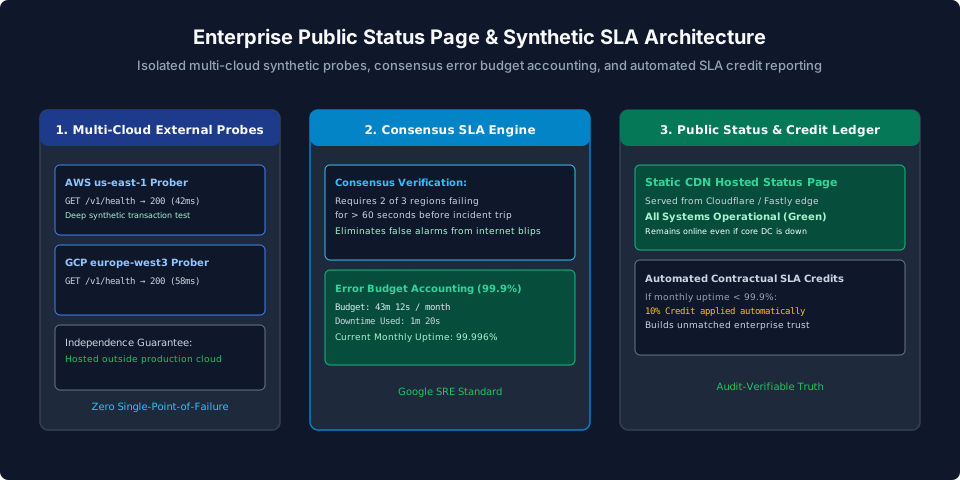
When an enterprise software buyer negotiates a multi-year, six-figure contract with your software company, their procurement team insists on one mandatory contractual exhibit: the Service Level Agreement (SLA).
The SLA is a legally binding commitment guaranteeing that your software will remain available for a specified percentage of time—commonly 99.9% ("three nines") or 99.99% ("four nines"). If your platform falls short of this threshold during any calendar month, the customer is contractually entitled to monetary billing credits or cash refunds.
During an outage, nothing destroys enterprise credibility faster than a public status page that displays "All Systems Operational" while the customer's executive team is staring at HTTP 500 errors. Conversely, an infrastructure team that hosts their status page on their own Kubernetes cluster—meaning the status page crashes when the application crashes—fails the basic test of operational professionalism.
To win and retain enterprise clients, you must build an independent, audit-verifiable status architecture: multi-cloud synthetic probes, consensus error budget accounting, and automated SLA credit engines. This guide provides the complete engineering blueprint.
The Mathematics of Uptime: 99.9% vs. 99.99%
Before offering uptime guarantees in customer sales negotiations, your engineering team must understand the mathematical reality of downtime allowances:
| SLA Commitment | Permitted Downtime / Month | Permitted Downtime / Year | Required Architectural Posture |
|---|---|---|---|
| 99.0% ("Two Nines") | 7 hours, 18 minutes | 3 days, 15 hours | Single cloud region; standard database automated backups |
| 99.9% ("Three Nines") | 43 minutes, 28 seconds | 8 hours, 45 minutes | Multi-AZ database clustering; zero-downtime expand/contract DDL |
| 99.99% ("Four Nines") | 4 minutes, 21 seconds | 52 minutes, 35 seconds | Multi-region active-active; automatic DNS failover; zero manual steps |
| 99.999% ("Five Nines") | 26 seconds | 5 minutes, 15 seconds | Global telecom grade; dual-cloud active synchronization |
Most cloud software platforms should commit to 99.9%. Committing to 99.99% requires multi-region database replication, multiplying cloud infrastructure expenses by 3x to 5x.
Rule #1: Complete Infrastructure Independence
A status page must never share any infrastructure, DNS, or network dependencies with your primary cloud application.
If your primary application runs in AWS us-east-1, and an AWS regional networking failure takes down your VPC:
- If your status page is in that same VPC, your status page goes dark.
- Customers cannot find information, inundating your support desk and tagging executives on social media.
The Isolated Hosting Model
Deploy your status page as pre-rendered static HTML/CSS files hosted on an independent global edge network:
- Primary cloud platform: AWS EKS / RDS in
us-east-1. - Public Status Page: Statically hosted on an edge static hosting network or independent CDN, reading status data from an isolated S3 bucket in a completely separate cloud account or object storage.
Even if your entire primary AWS organization suffers a catastrophic global outage, your status page remains online, responsive, and trustworthy.
Multi-Region Synthetic Probing and Consensus Quorums
How does your system determine whether your application is actually "down"?
A common flaw is relying on internal health checks (e.g. curl http://localhost:8080/healthz). A pod inside your Kubernetes cluster can report healthy even if the external edge load balancer is failing or corporate firewalls are blocking client traffic.
True End-to-End Synthetic Probes
Deploy external synthetic probe workers across three independent geographical regions (e.g. AWS Virginia, GCP Frankfurt, and Azure Singapore).
Every 30 seconds, each prober executes a complete synthetic user transaction:
- Negotiate TLS connection to
https://app.yourproduct.com. - Authenticate using a dedicated synthetic monitoring API key.
- Execute a read query:
GET /api/v1/workspaces/prober/ping. - Execute a fast write query:
POST /api/v1/workspaces/prober/ping(writes a timestamp to a dedicated test table). - Assert that the entire transaction completes in under 1,500 milliseconds.
[ AWS Virginia Prober ] ----+
                            |
[ GCP Frankfurt Prober ] ---+---> [ Consensus Engine ] ---> (If >= 2 regions fail for > 60s)
                            |                                  -> Declare Active Incident!
[ Azure Tokyo Prober ] -----+
The Consensus Quorum Rule
Never trigger an outage incident based on a single probe failure. Transient internet routing blips (BGP flap in Frankfurt) can cause one cloud region to fail temporarily while the rest of the world has perfect connectivity.
The Quorum Rule: Require at least two out of three independent regions to report transaction failures for two consecutive probing cycles (60+ seconds) before automatically changing public status from "Operational" to "Degraded Performance" or "Major Outage".
Calculating and Automating Contractual SLA Credits
Enterprise Master Services Agreements typically include a tiered refund matrix:
| Measured Monthly Availability | Contractual Customer Credit |
|---|---|
| 99.9% – 100.0% | 0% (Standard SLA fulfilled) |
| 99.0% – 99.89% | 10% of monthly subscription fee |
| 95.0% – 98.99% | 25% of monthly subscription fee |
| < 95.0% | 50% to 100% of monthly subscription fee |
The Power of Proactive Automated Credits
In standard corporate contracts, the customer must formally submit an SLA credit request in writing within 30 days of the incident to receive compensation.
Elite engineering organizations flip this dynamic: calculate and apply SLA credits automatically:
func (s *SLAService) ProcessMonthlyCredits(ctx context.Context, tenantID string, month time.Time) error {
	uptimePct := s.CalculateMonthlyUptime(ctx, tenantID, month)

	if uptimePct < 99.9 {
		creditPct := calculateCreditPercentage(uptimePct)
		mrr := s.billingRepo.GetTenantMRR(ctx, tenantID)
		creditAmount := mrr * creditPct

		// 1. Add credit balance directly to customer account in Stripe
		err := s.stripeClient.ApplyAccountCredit(ctx, tenantID, creditAmount,
			fmt.Sprintf("Automated SLA Credit: %.3f%% availability in %s", uptimePct, month.Format("January 2006")))
		if err != nil {
			return err
		}

		// 2. Dispatch executive notification to customer
		s.mailer.SendSLACreditNotice(ctx, tenantID, uptimePct, creditAmount)
	}

	return nil
}
When an enterprise customer receives an automated email stating: "We fell short of our 99.9% uptime commitment last month (achieving 99.82%). A 10% credit ($1,200) has been automatically applied to your next invoice," customer trust transforms completely. You convert an operational failure into a demonstration of integrity and reliability.
Summary Checklist for Production
- Decouple Status Hosting: Host your public status page on an independent edge network (edge CDN / isolated static host).
- Multi-Region Quorum Probing: Verify outages using consensus across at least 3 geographically distinct cloud regions.
- Deep Synthetic Checks: Probe real write and read transactions, not just static
/healthzpings. - Automate Error Budget Accounting: Track downtime minutes in an immutable database ledger.
- Contractual MSA Exclusions: Ensure your SLA contract explicitly excludes scheduled maintenance windows and third-party upstream carrier outages.
Frequently Asked Questions
Where should a cloud platform status page be hosted?
Host your status page on a completely isolated, independent cloud infrastructure—such as static files on an independent edge storage network, AWS S3/CloudFront in a separate account, or specialized providers like Statuspage.io.
What is the mathematical difference between 99.9% and 99.99% uptime?
99.9% ('three nines') allows 43 minutes and 28 seconds of downtime per month. 99.99% ('four nines') permits only 4 minutes and 21 seconds of downtime per month, requiring multi-region active-active architectures.
How do you distinguish deep application outages from simple HTTP 200 ping checks?
A basic `/healthz` endpoint checking if an application web server is running is inadequate. Synthetic probers must execute authenticated end-to-end transactions—such as logging in, querying a database, and validating an API response.
What is an Error Budget in Site Reliability Engineering (SRE)?
An error budget represents the allowable downtime over a rolling 30-day window (e.g. 0.1% for a 99.9% SLA). If the budget is exhausted, engineering halts non-essential feature releases to focus entirely on stability.
How should SLA financial credits be refunded to enterprise clients?
Apply SLA credits directly as a monetary discount line item on the customer's subsequent monthly or annual renewal invoice, accompanied by an executive incident post-mortem.
What are standard SLA credit penalty percentages in enterprise cloud platform?
Typical enterprise agreements award a 10% credit if uptime falls between 99.0% and 99.9%, a 25% credit between 95.0% and 99.0%, and a 50% to 100% credit if uptime drops below 95.0% in any calendar month.